
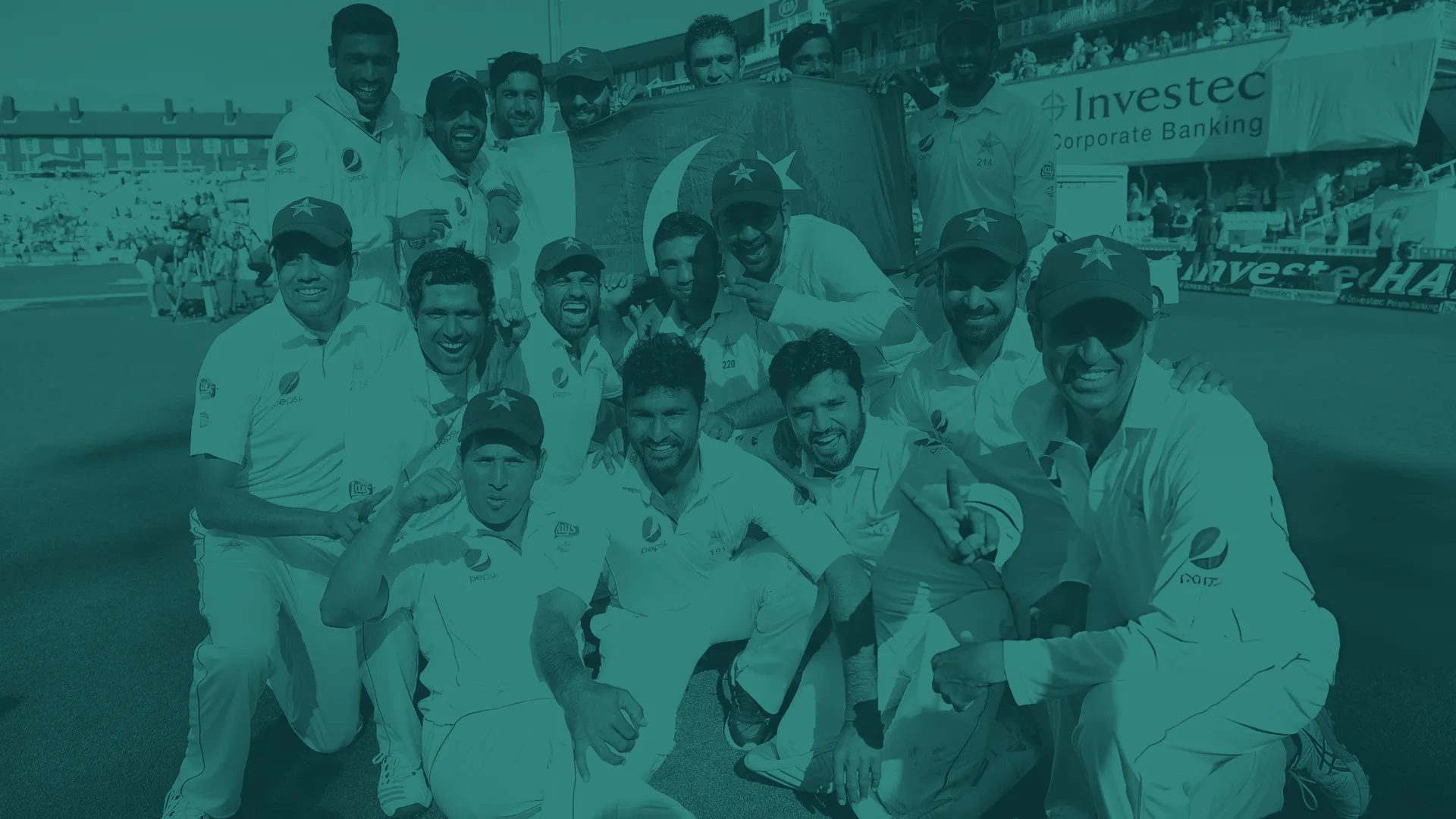
Pakistan in England: 72 Years of Test Drama
From Fazal Mahmood, Hanif Mohammad, Zaheer Abbas, Imran Khan and Javed Miandad to Wasim Akram, Waqar Younis, Saeed Anwar, Inzamam-ul-Haq, Younis Khan, Misbah-ul-Haq, Yasir Shah and Shan Masood, Pakistan’s Test history in England is filled with brilliance, controversy and moments that have endured across generations.
There are few places where Pakistan cricket has written quite as many chapters of its history as England.
For more than seven decades, the English summer has provided the stage on which generations of Pakistan cricketers have announced themselves, established their reputations and, at times, confronted the most searching challenges of their careers.
Some arrived as unknowns and left as stars. Others arrived as established names and produced performances that became part of cricketing folklore.
Fazal Mahmood taking 12 wickets at The Oval in 1954. Zaheer Abbas making 274 at Edgbaston in 1971. Mohsin Khan scoring a double hundred at Lord’s in 1982. Imran Khan taking 10 wickets at Headingley in 1987. Wasim Akram’s six-wicket haul at The Oval in 1992. Saeed Anwar’s 176 at The Oval in 1996. Younis Khan’s magnificent 218 in 2016. Mohammad Abbas’s eight wickets at Lord’s in 2018. Shan Masood’s 156 at Old Trafford in 2020.
These are not merely numbers. They are landmarks in the story of Pakistan cricket.
But the Pakistan-England rivalry has never been defined by what happened between the boundary ropes alone. Its history also contains disputes, allegations, disciplinary battles and controversies that reverberated far beyond the cricket field.
In 1987, the English media’s criticism of Pakistan prompted a strong response from team manager Haseeb Ahsan. In 1992, accusations of ball tampering followed Pakistan around the tour. In 2006, The Oval Test descended into one of the most extraordinary episodes in Test history when Pakistan refused to take the field after tea following the umpires’ decision that the ball had been illegally altered. England were awarded the match by forfeiture — the only such instance in Test cricket.
Four years later, the 2010 Lord’s Test became synonymous with the spot-fixing scandal involving Salman Butt, Mohammad Asif and Mohammad Amir. All three were subsequently convicted and imprisoned in Britain, while the ICC imposed substantial bans. The episode remains one of the darkest chapters in the history of Pakistan cricket.
And then there are the images that can soften even the most complicated history.
Few have been more enduring than Misbah-ul-Haq’s celebration after his century at Lord’s in 2016: a salute to his team on the Pavilion balcony followed by 10 press-ups. The gesture reflected the fitness training Pakistan had undertaken with army instructors before the tour. When Pakistan completed a famous 75-run victory, the entire team repeated the celebration.
As Pakistan return to England in 2026 for their 17th Test series there, the past offers a remarkable catalogue of performances and personalities.
Here are some of the tours and moments that have shaped that history.
1954 – Pakistan announce themselves
Pakistan’s first Test tour of England was historic before a ball was bowled. Playing four Tests in their inaugural series in England, A.H. Kardar’s Pakistan drew two, lost one and won one – becoming the first side to win a Test in England on its maiden tour.
The victory came at The Oval, where Fazal Mahmood produced one of the defining bowling performances in Pakistan’s early history. He took six for 53 and six for 46 as Pakistan successfully defended 168 to win by 24 runs.
No Pakistan batter made a century, but Hanif Mohammad was the leading run-scorer with 181. Fazal finished with 20 wickets in the series, sharing the leading tally with England’s John Wardle.
For a young cricket nation, it was an extraordinary beginning.
1967 — Hanif’s Lord’s hundred and Asif’s rescue act
Pakistan returned to England in 1967 under Hanif Mohammad, four years after losing four of five Tests during the 1962 tour. The three-Test series was lost 2-0, but there were moments of considerable individual brilliance.
Hanif made 187 at Lord’s, while Asif Iqbal emerged as Pakistan’s leading run-scorer with 267. His 146 in the second innings at The Oval was particularly memorable: Pakistan were 65 for eight when Asif and Intikhab Alam added 190 for the ninth wicket.
Asif’s influence was not confined to the bat. He also took 11 wickets in the series, underlining the all-round ability that would become a hallmark of his career.
1971 — Zaheer Abbas arrives, Imran Khan begins
The 1971 series was a pivotal one. England won 1-0, but Pakistan left with two stories that would become central to the game’s history.
At Edgbaston, Zaheer Abbas announced himself with a monumental 274 — still one of the most elegant and imposing innings ever played by a Pakistan batter in England. It came in only his second Test, and the innings immediately marked him out as a player of extraordinary class. The PCB records his Edgbaston 274 as the performance that heralded his arrival on the international stage.
The same Test also marked Imran Khan’s debut. He scored five in the first innings and bowled 23-9-36-0 and 5-0-19-0. What followed over the next two decades would turn him into one of the most influential all-rounders in cricket history.
Zaheer finished the series with 386 runs, while Asif Masood led Pakistan’s bowlers with 13 wickets.
1982 — Lord of Lord’s & Man with the Golden Arm
After drawn and lost series in 1974 and 1978, respectively, Pakistan arrived in England in 1982 under Imran Khan. England won at Edgbaston despite Imran taking nine wickets in the match. At Lord’s, however, Pakistan produced one of the defining victories of the tour.
Mohsin Khan scored 200, while Mudassar Nazar’s six-wicket second-innings haul helped Pakistan win by 10 wickets. The performance gave rise to two memorable descriptions: Mohsin became the “Lord of Lord’s”, while Mudassar was dubbed the “Man with the Golden Arm”.
At Headingley, Imran was outstanding again, taking five for 49 and three for 66 and contributing 67 not out and 46 with the bat. Even that was not enough to prevent England from winning by three wickets and taking the series 2-1.
1987 — Imran’s Headingley masterclass
Four years later, Pakistan finally won a Test series in England outright. The five-Test contest ended 1-0 after two matches were heavily affected by weather and another ended in a tense draw.
The decisive victory came at Headingley, where Imran Khan took 10 wickets as Pakistan won by an innings and 18 runs. Wasim Akram also contributed five wickets and 43 with the bat, while Saleem Malik made 99.
The final Test at The Oval produced another extraordinary Pakistan batting display. Javed Miandad made 260, Saleem Malik 102 and Imran 118 as Pakistan amassed 708. Abdul Qadir then took seven for 96 as England were dismissed for 232. The match ended in a draw, but the series belonged to Pakistan.
Miandad was their leading run-scorer with 360, while Imran and Wasim finished with 21 and 16 wickets respectively.
1992 — Wasim and Waqar turn reverse swing into an art
Pakistan’s 1992 tour came in the same year as their World Cup triumph and produced another series victory in England. Javed Miandad’s side won 2-1 in a five-Test contest, with Saleem Malik leading Pakistan’s batting with 488 runs and Aamir Sohail contributing 413.
The Lord’s Test was the defining early moment. Wasim Akram produced a match-winning performance as Pakistan won by two wickets. At The Oval, Pakistan completed the series victory in emphatic fashion. Wasim took six for 67 and three for 36, while Waqar Younis claimed five for 52 in the second innings as England were beaten by 10 wickets.
Wasim finished with 22 wickets and Waqar 21.
The series also reflected the growing mastery of reverse swing that would make the pair one of the most feared new-ball combinations in the world.
1996 — Inzamam, Saeed and another series victory
Pakistan returned to England four years later and completed another series win. Wasim Akram’s side won 2-0, with one Test drawn.
At Lord’s, Inzamam-ul-Haq made 148 and Pakistan won by 164 runs. At The Oval, Saeed Anwar produced a brilliant 176 and Saleem Malik scored 100 as Pakistan secured a nine-wicket victory.
Saeed finished the series with 362 runs, while Ijaz Ahmed made 344. With the ball, Mushtaq Ahmed claimed 17 wickets and Waqar Younis 16.
The series confirmed Pakistan’s growing comfort in English conditions and extended their remarkable run of success.
2001 — Saqlain, Waqar and Old Trafford
The 2001 series was more evenly contested. England won the first Test by an innings and nine runs at Lord’s, but Pakistan responded in the second at Old Trafford. Inzamam-ul-Haq made 114 and 85, while Saqlain Mushtaq (four for 74) and Waqar Younis (three for 85) helped Pakistan bowl England out in the second innings to win by by 108 runs to square the two-Test series 1-1.
It was a modest-looking scoreline compared with some of the dramatic series that preceded it, but Inzamam’s 232 runs made him the outstanding Pakistan batter.
2006 — The Oval controversy that refused to go away
The English cricket summer of 2006 will forever be remembered for the extraordinary events at The Oval. Pakistan were in a commanding position when, on the fourth day, umpire Darrell Hair ruled that the condition of the ball had been unfairly altered and awarded England five penalty runs under the Laws. Pakistan, led by Inzamam-ul-Haq, refused to take the field after tea in protest. Hair and fellow umpire Billy Doctrove subsequently awarded the Test to England by forfeiture — the first and, to date, only forfeited Test in cricket history.
The controversy continued long after the players had left The Oval.
At the subsequent ICC hearing, Chief Match Referee Ranjan Madugalle cleared Pakistan of the ball-tampering charge, saying the evidence was insufficient to establish that the fielding side had changed the condition of the ball. Inzamam, however, was found guilty of bringing the game into disrepute for refusing to resume play and was suspended for four ODIs.
Meanwhile, Hair became embroiled in a separate controversy when correspondence revealed that, two days after the Test, he had offered to resign from the ICC’s elite umpiring panel in return for a one-off payment of US$500,000. He subsequently withdrew the offer.
The saga took another remarkable turn in July 2008, when the ICC Board changed the result from an England win by forfeiture to a draw. The decision prompted former West Indies fast bowler Michael Holding, then a member of the ICC Cricket Committee, to resign in protest, arguing that Pakistan’s refusal to take the field should not go unpunished even though they had been cleared of ball-tampering.
The ICC eventually reversed its 2008 decision in January 2009 and restored the original result, leaving England as the winners of a Test that had become one of the most contentious episodes in cricket history.
For Pakistan, the episode was inseparable from the wider story of a series England won 3-0.
Amid the turmoil, Mohammad Yousuf produced an extraordinary batting campaign, scoring 631 runs and three centuries. Umar Gul took 18 wickets and Danish Kaneria 13.
2010 — A series overshadowed by scandal
England won the 2010 series 3-1, but the cricket itself was eventually eclipsed by the events of the Lord’s Test. Pakistan, 2-0 down, won at The Oval after Wahab Riaz took five for 63 in England’s first innings, Mohammad Amir claimed five for 52 in the second and Salman Butt helped Pakistan chase 148.
At Lord’s, however, the News of the World investigation exposed the spot-fixing conspiracy involving captain Salman Butt, Mohammad Asif and Mohammad Amir. The three were subsequently convicted in Britain. Butt received a 30-month prison sentence, Asif one year and Amir six months; all three were also banned from cricket by the ICC.
Amir eventually returned to international cricket in 2015. Butt and Asif did not return to Pakistan’s international side.
The Lord’s Test consequently became much more than a cricket match. It became a watershed moment for the sport’s fight against corruption.
2016 — Misbah’s push-ups and salute, Younis’s 218
If the 2006 and 2010 tours left painful memories, the 2016 series produced some of the most uplifting images in Pakistan’s history in England. At Lord’s, Misbah-ul-Haq became the oldest Test captain to score a century when his 114 helped Pakistan to a famous 75-run victory.
His celebration – a salute followed by 10 press-ups – became instantly iconic. The gesture paid tribute to the Pakistan Army instructors who had assisted with the team’s fitness preparations. The entire Pakistan side repeated the celebration after the 75-run victory.
England responded by winning at Old Trafford by 330 runs and at Edgbaston by 141.
But Pakistan had the final word.
At The Oval, Younis Khan produced one of the great Pakistan innings in England, making 218. Asad Shafiq added 109 and Pakistan turned England’s 328 into 542. Yasir Shah then took five for 71 as England were dismissed for 253. Pakistan needed only 40 in the fourth innings and won without losing a wicket.
The series ended 2-2. Younis scored 340 runs, Misbah 282 and Azhar Ali 295, while Yasir led the bowlers with 19 wickets.
2018 — Abbas owns Lord’s
Pakistan returned to England two years later and produced another memorable Lord’s performance. Mohammad Abbas was the architect. The right-arm seamer took eight for 64 in the match as Pakistan won by nine wickets. His precision, movement and relentless accuracy proved devastating in conditions that rewarded discipline.
Pakistan won the opening Test before England levelled the two-match series at Headingley. The 1-1 result nevertheless left Abbas’s name permanently attached to one of Pakistan’s finest modern bowling performances at Lord’s.
2020 — Shan Masood’s resistance in the pandemic summer
The 2020 tour was unlike any before it. Played during the Covid-19 pandemic, the series took place amid biosecure protocols and an atmosphere unlike anything experienced in previous Pakistan-England contests.
At Old Trafford, Shan Masood provided one of the defining batting performances of the series. His 156 from 319 balls anchored Pakistan’s first innings of 326. He batted for almost eight hours and absorbed the pressure of England’s attack in conditions that demanded patience and judgement.
Pakistan established a first-innings lead of 107, but England recovered. Pakistan were dismissed for 169 in the second innings, leaving England 277 to win. Chris Woakes, unbeaten on 84, and Jos Buttler, who made 75, added 136 for the sixth wicket to rescue England and secure a three-wicket victory.
England eventually won the three-Test series 1-0.

GRC Staff
Lorem ipsum dolor sit amet, conse ctetuer adipiscing elit, sed diam nonum nibhie. Aenean sollici tudin, lorem auci elit consequat ipsutis sem niuis sed odio sit amet nibh vulputate cursus.


Leave a Reply