

When Pakistan Made Test Cricket Beautiful
For generations, Pakistan did more than win Test matches. They produced cricketers of skill, swagger and individuality who made the world want to watch. The results have faded, but the inheritance remains — and it is now for another generation to carry it forward.
There was a time when Pakistan did not have to search for an identity in Test cricket. Everybody else knew what it was.
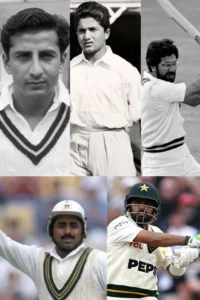
It was Hanif Mohammad occupying the crease as though surrender were a character flaw. Fazal Mahmood, immaculate and devastating, making the ball obey him. Zaheer Abbas caressing attacks rather than conquering them. Majid Khan making batting appear impossibly easy. Javed Miandad fighting every contest as though it were personal. Abdul Qadir transforming leg-spin into theatre.
And then there was the legendary Imran Khan, the flamboyant and charismatic all-rounder whose exploits on the field established him as one of the greatest to have played the game and earned Pakistan a unique place in world cricket. His departure from international cricket in 1992, following Pakistan’s historic World Cup triumph in Melbourne, marked the end of an era, but his legacy has endured. His remarkable achievements, memorable performances, inspirational leadership and innovative ideas that helped shape the game continue to be celebrated, shared and remembered across the cricketing world.
The post-Imran era saw Wasim Akram, Waqar Younis and Shoaib Akhtar, three fast bowlers who could make a cricket ball perform acts that seemed to defy physics; Saeed Anwar’s elegance, Inzamam-ul-Haq’s languid brilliance, Mohammad Yousuf’s grace, and Younis Khan’s relentless appetite for runs.
Different eras. Different personalities. One unmistakable cricketing country.
Pakistan did not merely play Test cricket. Pakistan made Test cricket beautiful.
That is worth remembering now, not because the past should become a refuge from an uncomfortable present, but because history can sometimes remind a sporting nation of the standards it once considered normal.
Pakistan’s Test story began in India in October 1952. By only their second Test, they had won, Fazal taking 12 wickets at Lucknow. Two years later came the performance that announced them to the old cricketing world: England were beaten by 24 runs at The Oval, Fazal taking 12 for 99, and Pakistan drew their first series in England 1-1.
A new Test nation had taken barely two years to win in England. That first generation supplied something more important than numbers: credibility.
Hanif supplied permanence. His 337 against West Indies in Bridgetown in 1958, compiled over 970 minutes to save a Test after Pakistan had followed on, remains the longest innings by time in Test history.
Pakistan’s cricketing personality was already forming: technically accomplished, stubborn, unconventional and capable of astonishing acts when apparently cornered.
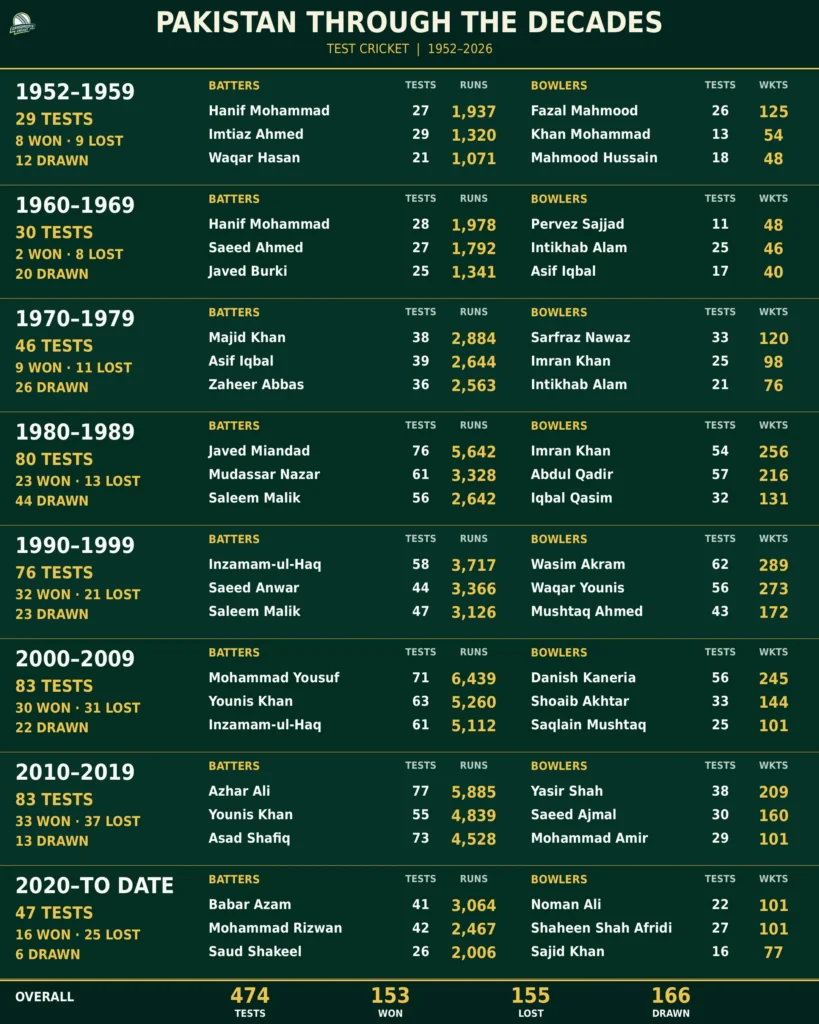
The numbers across the decades tell the story of what followed.
Pakistan played 29 Tests in the 1950s and won eight. The 1960s were more difficult — only two victories in 30 Tests — but another generation was emerging. By the 1970s, Majid Khan, Asif Iqbal and Zaheer Abbas were Pakistan’s leading run-scorers of the decade; Sarfraz Nawaz and Imran Khan were among the leading wicket-takers.
Pakistan were no longer cricket’s intriguing newcomers. They were becoming a serious cricketing force.
THE DECADE WHEN EVERYTHING CAME TOGETHER
And then came the 1980s. Perhaps no decade better explains the romance surrounding Pakistan Test cricket.
Across 80 Tests between 1980 and 1989, Pakistan won 23 and lost only 13. The raw numbers are impressive. The names behind them are magnificent.
Miandad scored 5,642 runs during the decade. Imran took 256 wickets. Qadir claimed 216.
Yet statistics alone cannot explain their hold on the imagination.
Miandad embodied resistance. Qadir gave an art thought to be disappearing from Test cricket a new swagger. Imran combined pace, skill, athleticism, charisma and leadership in a manner Pakistan had never previously seen.
Around them was a side developing the conviction that reputation and geography were no reasons to be intimidated.
Pakistan swept Australia 3-0 at home in 1982-83 and then beat India 3-0. There were reversals — Australia beat them 2-0 in 1983-84 and New Zealand did the same in 1985 — which is important when remembering the past. Great Pakistan teams lost, sometimes badly.
What distinguished them was their capacity to respond. The defining stretch arrived towards the decade’s end.
Pakistan went to India in 1987 and won the five-Test series 1-0. Months later, they travelled to England and won another five-Test series 1-0. The following winter they beat England 1-0 at home.
Then came perhaps the ultimate examination: West Indies in the Caribbean in 1988. This was West Indies at the height of their power. Pakistan did not defeat them, but neither could West Indies defeat Pakistan. The three-Test contest finished 1-1.
In an era dominated by arguably the most fearsome Test side cricket has known, Pakistan could look them in the eye.
That matters more than any retrospectively calculated ranking.
CHAOS, CONTROVERSY — AND IRRESISTIBLE CRICKET
If the 1980s established Pakistan among the game’s powers, the 1990s demonstrated one of the strangest characteristics of Pakistan cricket: its ability to produce excellence amid turbulence.
It was a decade of captaincy upheavals, dressing-room divisions and serious allegations and investigations around the game. It should have overwhelmed the cricket.
Somehow, extraordinary cricket kept breaking through.
Pakistan won 32 of 76 Tests during the decade — nine more victories than in the 1980s despite playing four fewer matches.
Look at the performers.
Inzamam scored 3,717 runs during the decade, Saeed Anwar 3,366 and Saleem Malik 3,126. At the other end of the scorecard were numbers that still stir the imagination: Wasim Akram, 289 wickets; Waqar Younis, 273; Mushtaq Ahmed, 172.
Wasim and Waqar in particular represented something quintessentially Pakistani. They weren’t manufactured from a template. They were different, aggressive, spectacular and capable of changing a Test in a devastating spell.
Pakistan won in England in 1992. They returned in 1996 and won 2-0. They beat Australia at home in 1994 and West Indies 3-0 in 1997.
The fascination was not merely whether Pakistan would win. It was how they might do it.
That perhaps is what has become hardest to quantify when looking back. Pakistan possessed cricketers whom neutral supporters wanted to watch. There was personality in the cricket — sometimes too much of it — but rarely anonymity.
THE INHERITANCE SURVIVED
It would be convenient, but wrong, to suggest that Pakistan’s great Test tradition ended with the 1990s. In fact, they won 30 Tests in the 2000s and 33 in the 2010s, more in each decade than during the celebrated 1980s.
The custodians changed.
Mohammad Yousuf amassed 6,439 Test runs during the 2000s, Younis Khan 5,260 and Inzamam 5,112. Danish Kaneria took 245 wickets, Shoaib Akhtar 144 and Saqlain Mushtaq 101.
There were still performances capable of reminding the world who Pakistan were: England beaten 2-0 in 2005-06, India 1-0, Sri Lanka 1-0 and West Indies 2-0 immediately afterwards.
Then Pakistan cricket was confronted by something previous generations had never experienced on the same scale: the loss of Test cricket at home.
For years, the UAE became home. And from that displacement emerged another formidable Pakistan side.
It did not possess quite the flamboyance associated with some predecessors. Its personality was different: resilience, patience, discipline.
Pakistan swept England 3-0 in 2012. Australia were beaten 2-0 in 2014. England lost 2-0 in 2015. Pakistan won in Sri Lanka and, in 2016, went to England and drew 2-2.
Then came something no Pakistan side had officially achieved before.
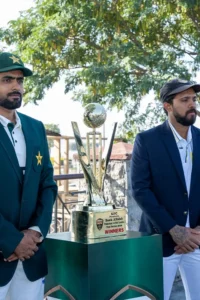
On August 22, 2016, Misbah-ul-Haq’s team became No.1 in the ICC Test Team Rankings, the first Pakistan side to do so since the current rankings system was introduced in 2003.
The symbolism was extraordinary.
When Misbah received the Test Championship mace in Lahore from ICC Chief Executive, David Richardson, Pakistan had not played a home Test there for seven years. The journey to No.1 had effectively been completed in exile.
Hanif and Fazal’s inheritance had survived. It had simply changed hands.
AND NOW?
That is what makes the present uncomfortable.
Pakistan’s record from 2020 onwards reads: 47 Tests, 16 wins, 25 defeats and six draws.
The individual numbers still identify considerable talent. Babar Azam leads Pakistan’s run-scoring for the period with 3,064; Mohammad Rizwan has 2,467 and Saud Shakeel 2,006. Noman Ali and Shaheen Shah Afridi have each taken 101 wickets, with Sajid Khan on 77.
There have been good days. There have been series victories.
But there has also been a frequency of defeat — including damaging results at home — that sits uneasily beside the standards established over seven decades.
This is where nostalgia can become dangerous.
Pakistan cannot solve today’s problems by asking where the next Imran is, demanding another Miandad or waiting for another Wasim and Waqar. Those players belonged to their time. Today’s cricketers must belong to theirs.
Nor was yesterday perfect.
The old Pakistan lost Tests and series. Administrators made mistakes. Selection could be chaotic. Players quarrelled. The 1990s in particular were anything but a golden age of governance.
The lesson is not that everything used to be better. It is that Pakistan cricket repeatedly found ways to ensure its talent survived its problems.
That is the inheritance today’s administrators, selectors, coaches and players have been given.
Pakistan need a first-class system capable of preparing cricketers for Test cricket; pitches that develop skills rather than merely chase short-term results; selection that rewards performance and offers continuity; administrators capable of thinking beyond the next series; and, above all, a renewed conviction that Test cricket matters.
The players have responsibilities too. A Pakistan Test cap comes with no entitlement to greatness. But it does come with history.
Fazal wore it. Hanif wore it. Zaheer, Majid and Sarfraz wore it. Imran, Miandad and Qadir wore it. Wasim, Waqar, Inzamam, Shoaib and Saeed Anwar wore it. Yousuf and Younis wore it. Misbah and Sarfaraz Ahmed wore it.
Each generation received something from the one before it and was then asked to leave something for the one that followed.
That chain must not be allowed to break.
Because the purpose of remembering Pakistan’s glory days should never be to tell today’s cricketers that they cannot compare with yesterday’s heroes.
It should be to remind them of what is possible.
Pakistan were once feared abroad, formidable at home, blessed with individualists and capable of confronting the strongest teams in the world without apology. They produced batters people stayed awake to watch and bowlers for whom spectators bought tickets. They could be infuriating and magnificent, occasionally both in the same afternoon.
They made generations fall in love with Test cricket.
That history does not belong in a museum.
It belongs to the next Pakistan cricketer who takes the ball believing he can win a Test overseas; the next batter who decides that a difficult fourth innings is an opportunity rather than an ordeal; the next captain who demands standards rather than excuses; and the next administrator prepared to build something that might outlast his tenure.
Pakistan do not need to become the team of 1954, 1987, 1992 or 2016 again.
They need to build the next one.
And perhaps, one day, another generation will look back at today’s players with the same affection and say: That was when Pakistan made Test cricket beautiful again.

GRC Staff
Lorem ipsum dolor sit amet, conse ctetuer adipiscing elit, sed diam nonum nibhie. Aenean sollici tudin, lorem auci elit consequat ipsutis sem niuis sed odio sit amet nibh vulputate cursus.



Leave a Reply