

Batting Boom, Bowling Blind Spot: What The Quaid-e-azam Trophy Reveals About Pakistan Cricket
The 2025-26 Quaid-e-Azam Trophy ended with wild-card entrants Karachi dismantling defending champions Sialkot by 218 runs at Gaddafi Stadium to claim their 22nd title. Beyond the scoreline and celebrations, the tournament served as something more important: a live health check on Pakistan cricket.
With ten city-based sides playing each other in a single-league format and the top two progressing to the final, the country’s leading cricketers – especially those on the fringes of international selection – had a fair, equal platform to display skill, temperament and match fitness against all opposition in broadly similar conditions. In that sense, the competition did what a premier domestic tournament in a major cricket nation should do: it revealed the true strength and shape of the game beneath the international level.
What emerged over two months should both encourage and concern Pakistan’s cricket administrators.
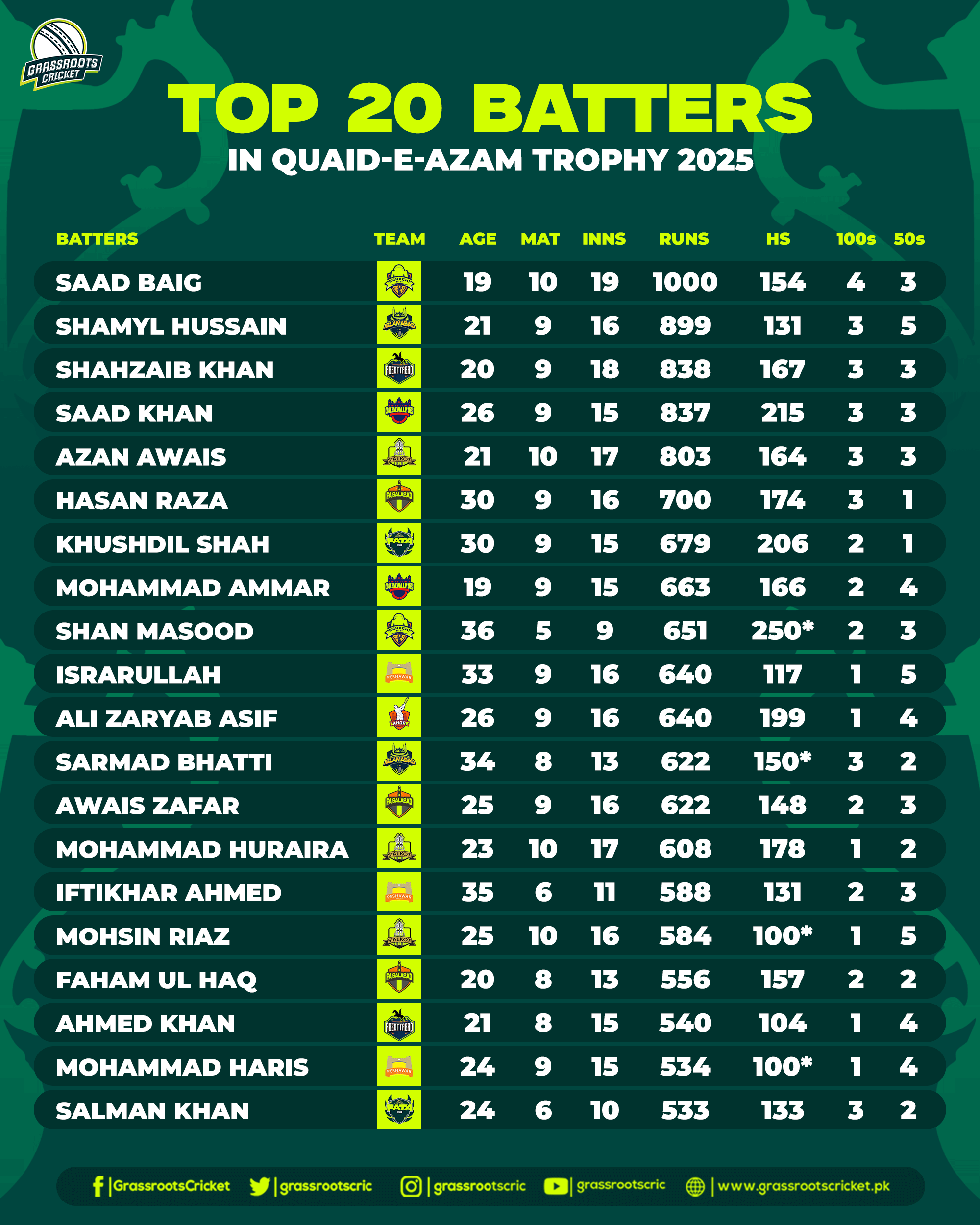
The most encouraging sign came from the batting charts.
The average age of the top 20 run-scorers was 25.6, suggesting a healthy churn of young batters ready to push upwards. The top five batters were all between 19 and 26 years of age. They did not merely fill spots; they outperformed and, in some cases, displaced more established names. That is exactly what a selector wants to see when planning medium- and long-term batting resources.
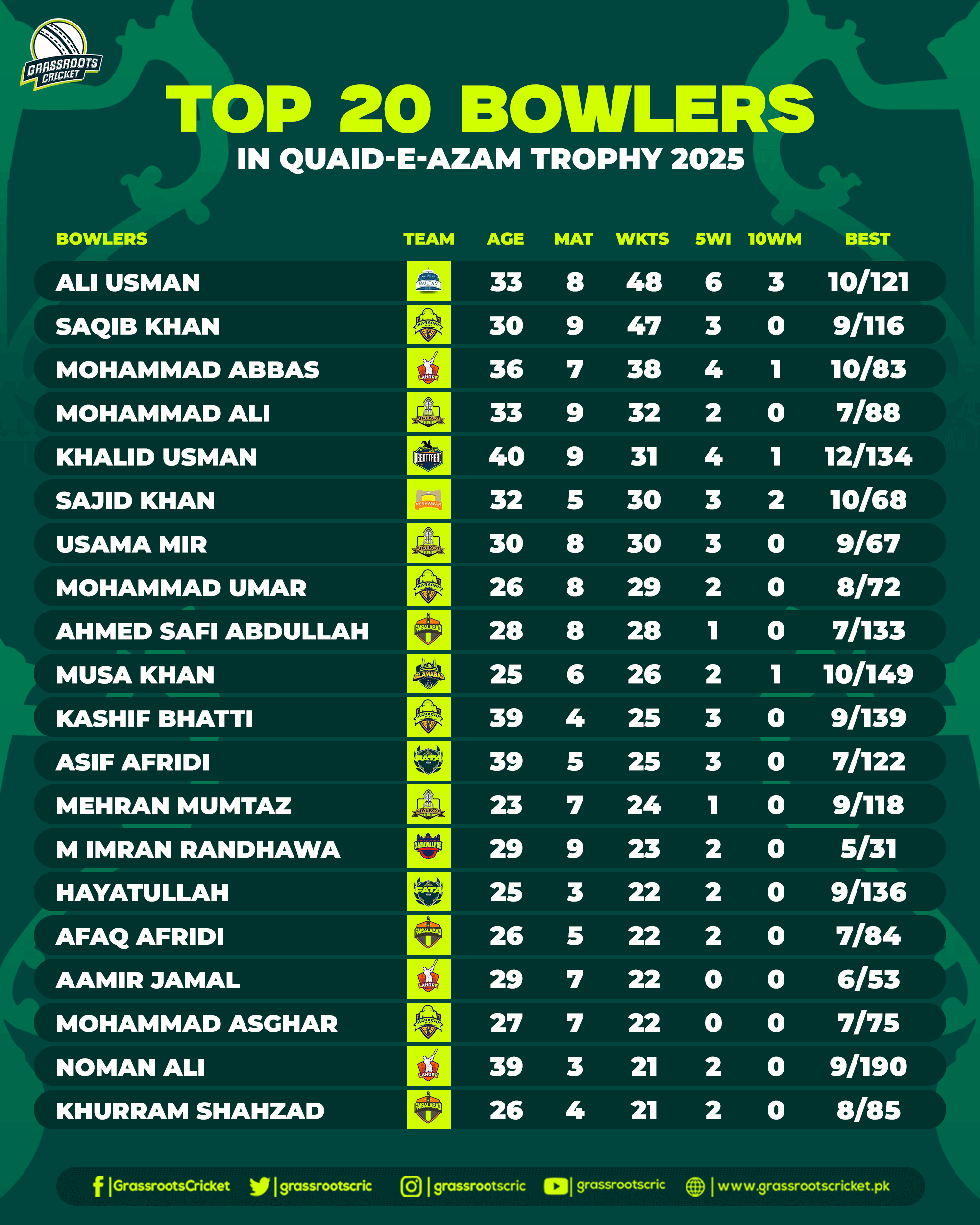
The bowling statistics told a different story.
The average age of the top 20 wicket-takers was 29.25, a significantly higher figure and a less reassuring one. The top four bowlers, all fast bowlers, were between 30 and 36. The leading spinner was Abbottabad’s 40-year-old Khalid Usman, followed by Peshawar’s 32-year-old Sajid Khan. These senior professionals deserve enormous credit: at an age when many bowlers either retire or reduce workloads, they remain fit, skilful and competitive enough to dominate a demanding first-class competition.
Yet when older bowlers are consistently carrying the bulk of the workload and the younger crop is largely absent from the top bracket, the question shifts from individual performance to system design. Is Pakistan identifying, preparing and trusting enough under-25 bowlers to take over, or is the domestic structure leaning too heavily on experience because the next generation has not been adequately developed?
Age alone should never be a disqualifier. Selection must always rest on form, fitness and performance, and every cricketer who delivered consistently across the tournament deserves full praise.
But the collective pattern – young batters thriving while older bowlers shoulder responsibility – points to a structural imbalance in how Pakistan is developing its bowling resources.
The list of leading wicket-takers underlines this. Among the top 20, only a few can genuinely be called young by professional standards: 23-year-old Mehran Mumtaz and 25-year-olds Mohammad Musa Khan and Hayatullah stand out.
Beyond them, a small group of promising quicks had only a light taste of first-class cricket, with limited impact. Eighteen-year-old Mohammad Razaullah from Abbottabad played one match. Multan’s 19-year-old fast bowler Mohammad Shan featured in four. Lahore’s 20-year-old quicks, Ubaid Shah and Mohammad Salman, appeared in three and two matches respectively, while Multan’s 20-year-old Mohammad Ismail played seven.
On its own, this could be explained by competition for spots. In context, however, it coincides with a significant gap in the development pathway: the Pakistan U19 Championship, a three-day tournament that has traditionally been the bridge between age-group and first-class cricket, was not held last year. When that link disappears from the calendar, fewer teenagers are tested over multiple days, fewer potential red-ball bowlers are identified early, and fewer are naturally fed into Quaid-e-Azam squads.
The result is what this season has exposed: veteran bowlers remain indispensable, not only because they are still effective, but because the pipeline pushing them from below is thinner than it should be.
There was one major positive this season that can help correct this trend: the participation of Shan Masood. Pakistan’s Test captain played in the Quaid-e-Azam Trophy at a time when he also serves as the PCB’s Consultant, International Cricket and Players’ Affairs.
That combination gives Shan something most administrators lack in real time – direct exposure to domestic players’ standards, temperaments and readiness from within the dressing room and out in the middle. He now has first-hand knowledge of which players are close to international level, which skills are missing, and which parts of the system are holding progress back.
For the PCB, this is a strategic opportunity. Shan is uniquely positioned to connect what he has seen in domestic cricket with what is required at international level. If his experience this season is used actively, it can drive reforms in the talent pathway rather than be remembered as a one-off domestic stint by a national captain.
Repairing and strengthening the ladder beneath the Quaid-e-Azam Trophy is the obvious starting point.
The Pakistan U19 three-day Championship must be restored as a permanent and protected event in the domestic calendar. That is where future fast bowlers and spinners should learn to bowl long spells, manage workloads, handle changing match situations and understand red-ball cricket over multiple days. Without that training ground, the system is effectively asking raw talent to leap directly from under-19 or white-ball cricket into the highest domestic level, which is neither efficient nor fair.
Beyond U19, the time has come to introduce a Pakistan U23 National Championship. This is an idea Shan Masood can reasonably champion in consultation with the Director of Domestic Cricket.
A dedicated U23 competition would provide a clear, visible route for U19 graduates instead of leaving them as occasional squad players or fringe options. It would create a strong second tier just below Quaid-e-Azam level, where younger batters and bowlers can compete regularly and push for promotion. In simple terms, U19 would identify, U23 would prepare, and the Quaid-e-Azam Trophy would confirm.
The next critical question is what happens to those who excelled this season.
The Pakistan Shaheens programme currently exists but remains limited. Pakistan’s next Test assignment is not until the summer of 2026. That gap is dangerous if left unplanned. Cricketers who have just produced career-defining domestic seasons cannot be allowed to drift into long periods of inactivity and then be asked to restart again from scratch a year later.
Selectors and high-performance planners need to design a continuous, competitive calendar for these players – a sequence of Shaheens and A-team tours, targeted red-ball and white-ball series, and specialised fast-bowling and spin camps that keep them bowling, batting and evolving under pressure.
On the batting front, the selectors are far better served.
Beyond the top five run-getters, a long list of young batters signalled readiness for higher honours. Saad Baig, Shamyl Hussain, Shahzaib Khan, Saad Khan, Azan Awais, Mohammad Ammar, Awais Zafar, Mohammad Huraira, Faham ul Haq and Ahmed Khan all impressed with sound technique, sensible stroke selection and an ability to adjust to conditions and match situations. They did not merely accumulate runs; they showed the temperament and game sense that travel well to international cricket.
Two names, in particular, stood out under pressure.
Twenty-year-old Haroon Arshad finished 32nd in the run charts with 436 runs in seven matches, including two centuries, one of them in the final. Twenty-three-year-old Abdullah Fazal scored 425 runs in six matches, won the Player of the Final award for his 83 and 114, and finished in 35th position. Performances like these on the biggest domestic stage are exactly what selectors look for when planning succession and depth.
Taken together, the Quaid-e-Azam Trophy reinforces a familiar reality: talent has never been Pakistan’s problem. The overall health of Pakistan cricket, as reflected in this tournament, is not poor. The country continues to produce cricketers with natural ability, flair and resilience.
The long-standing issues lie in how that talent is channelled – the transparency of selections, the clarity and continuity of pathways, and the volume and quality of opportunities given to young players to play, fail, learn and come back stronger.
With the PCB already investing more in domestic cricket, the next step must be to match that financial commitment with disciplined post-season planning. High performers should be tracked and supported, not left to wait passively for the next Quaid-e-Azam campaign. Promising bowlers need regular red-ball workloads, specialist coaching and meaningful competitions. Young batters need structured exposure to different formats and conditions. Age-group and second-tier tournaments should be ring-fenced rather than sacrificed when schedules tighten.
Ultimately, one central question now sits with Shan Masood and the PCB leadership: how, and how quickly, will the stand-out performers of this Quaid-e-Azam Trophy be moved to the next level of cricket?
If the board can restore the U19 Championship, introduce a U23 National Championship and build a robust, competitive schedule for Pakistan Shaheens and other representative sides, the Quaid-e-Azam Trophy will become more than an annual health report. It will sit at the heart of a continuous pathway that takes Pakistan’s best cricketers from promise to sustained international performance.
The raw material is clearly there. The 2025-26 Quaid-e-Azam Trophy has made that obvious. The responsibility – and the opportunity – now rests with the administrators.

GRC Staff
Lorem ipsum dolor sit amet, conse ctetuer adipiscing elit, sed diam nonum nibhie. Aenean sollici tudin, lorem auci elit consequat ipsutis sem niuis sed odio sit amet nibh vulputate cursus.




Leave a Reply