
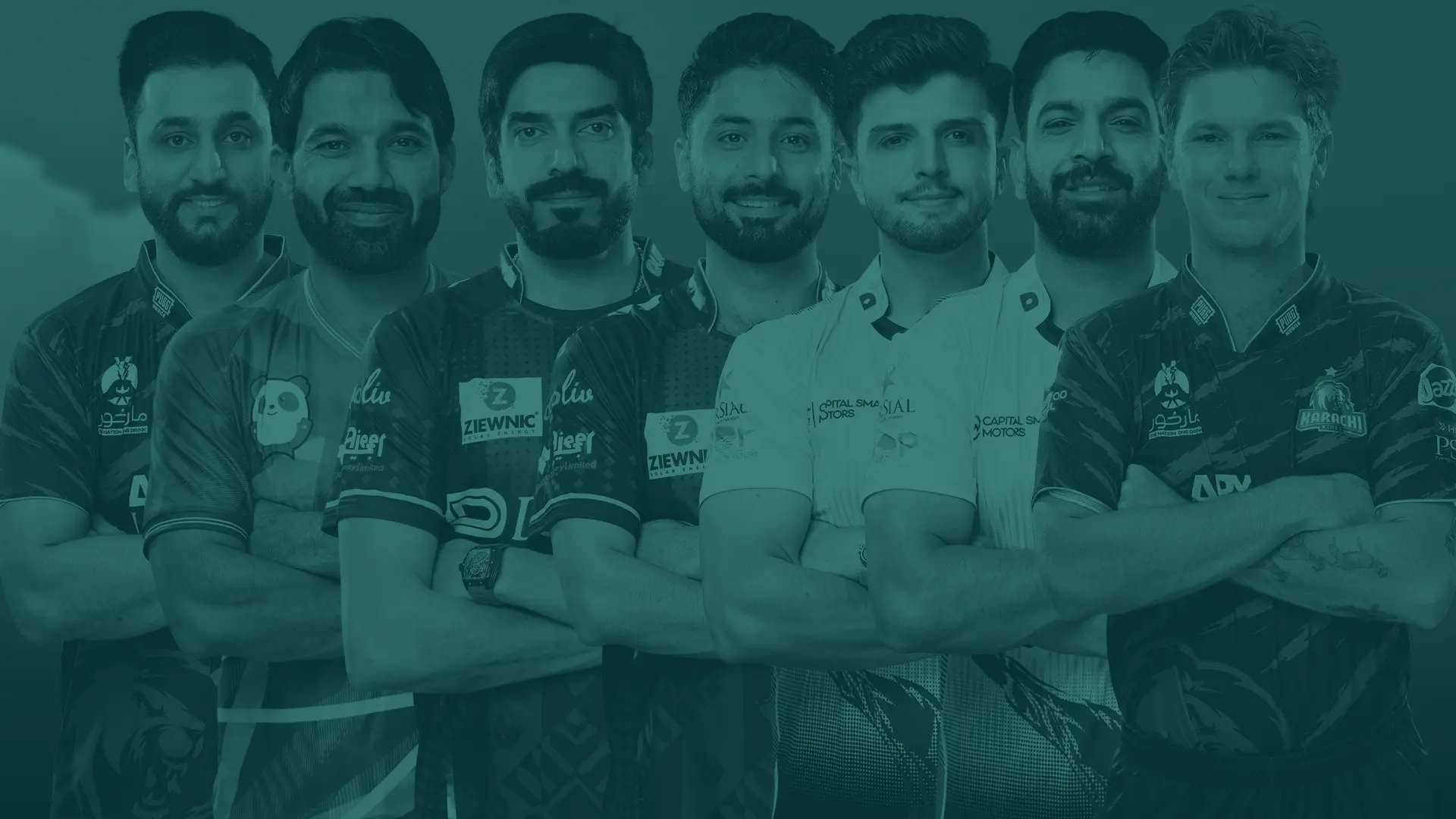
PSL 2026’s Biggest Disappointments
LAHORE: The Pakistan Super League 2026 has produced some breathtaking displays and record-breaking performances in the competition’s history. Babar Azam equalled Fakhar Zaman’s record of 588 runs in a single PSL season when he inspired his side to their fifth final while scoring his fourth PSL and 13th overall century. Babar’s team-mate Kusal Mendis became the first batter this season to break the 500-run mark and now has 541 runs, including a century. Usman Khan became the quickest batter to four PSL centuries, achieving the feat in just 33 matches. Teenage fast bowler Ali Raza became the seventh — and youngest — player to record a hat-trick in PSL history.
But for every player who lit up the tournament, there were some established and some emerging names — bought for significant sums, expected to be match-winners — who had a disappointing tournament.
Four sides failed to reach the play-offs: Karachi Kings, Lahore Qalandars, Quetta Gladiators and Rawalpindiz. The lack of form and consistency of their marquee players was a common thread running through each campaign.
Pakistan’s T20I captain Salman Ali Agha averaged just 12.44 with the bat. Australia’s Adam Zampa, a T20 World Cup winner with 147 T20I wickets, managed five wickets from seven matches. Haris Rauf conceded nearly 10 runs per over. And Mohammad Rizwan — one of Pakistan’s most decorated white-ball cricketers — lost 19 of his last 21 PSL matches as captain across two franchises.
That they struggled to deliver is worth examining — because in some cases the reasons go beyond poor form and speak to deeper issues of team selection, match strategy and management decisions that repeatedly backfired.
The combined cost of the nine players profiled here exceeds PKR440 million ($1.57 million). The returns were, in almost every case, woefully short of what was paid for.
SALMAN ALI AGHA (Karachi Kings)
Pakistan’s T20I captain Salman Ali Agha was one of the biggest local stars whose poor form played a significant part in Karachi Kings’ failure to record more than five victories — a result that led to their elimination in the group stage.
Salman aggregated 112 runs in nine innings from 10 matches at an average of 12.44 and a strike-rate of 119. To put that in context, Karachi Kings bought him for PKR58.5 million ($210,000) — making his runs among the most expensive in the tournament at roughly PKR522,000 per run scored.
His highest score of 29 came in the third match against Rawalpindiz. His other scores of note were 24 against Hyderabad Kingsmen and 22 against Quetta Gladiators. In the remaining matches, he scored 0 and 14 against Lahore Qalandars, 5 and 12 against Peshawar Zalmi, 4 against Islamabad United and 2 against Multan Sultans — a sequence that tells its own story about a batter who never found his footing throughout the competition.
With the ball, he managed just three wickets at an economy rate of 8.54 — below the standard expected of a frontline all-rounder at international level.
The comparison with his 2025 season is instructive — 201 runs from nine innings for Islamabad United. For a player of his international standing and match-winning reputation, PSL 2026 was a tournament to forget. Whatever the reasons, Karachi Kings paid dearly for a player who was unable to deliver when his side needed him most.
ADAM ZAMPA (Karachi Kings)
The numbers that Karachi Kings would have studied before buying Adam Zampa were compelling — 147 wickets from 115 T20I appearances for Australia, including 13 wickets in Australia’s ICC Men’s T20 World Cup 2021 title-winning campaign. The numbers he produced for them were considerably less so — five wickets from seven matches at an average of 43.20 and an economy rate of 7.71.
This was Zampa’s maiden PSL season and the pitfalls of a first appearance in Pakistan’s conditions were evident throughout. Ironically, his best performance came in just the second match against Lahore Qalandars — figures of 4-1-11-2 that earned him the Player of the Match award.
It was a false dawn. He was unable to replicate that control or wicket-taking threat in the matches that followed. An economy rate of 7.71 suggests he was not expensive by T20 standards, but five wickets at an average of 43.20 from a bowler of his pedigree represents a significant under-delivery.
Karachi Kings paid PKR45 million ($161,000) for a bowler who, on Pakistani surfaces against batters who read him quickly, never looked like the match-winner his record suggested he could be.
HARIS RAUF (Lahore Qalandars)
Lahore Qalandars’ failure to reach the play-offs for the seventh time in 11 editions was largely due to their bowlers’ inability to back their batters and deliver in crunch situations. Haris Rauf, bought for PKR76 million ($272,000) — the most expensive of the nine players profiled here — was the most glaring example.
Although Haris was Lahore Qalandars’ second most successful bowler, his 12 wickets from nine matches came at an economy rate of 9.79 and an average of 24.08. For a specialist T20 fast bowler of his international standing, these figures don’t paint a positive picture — particularly when Lahore’s margins of defeat were often narrow enough that tighter bowling could have changed outcomes.
After starting impressively with two for 22 against Hyderabad Kingsmen, Haris was struck for a six and a four off successive balls by Karachi Kings’ Abbas Afridi in the last over to seal victory for the home side, finishing with figures of 3.3-0-45-1. Qalandars were defending just 128 runs in the match. Haris conceded 26 from two overs against Multan Sultans — who fell short by 20 runs — and leaked 10 from his only over in the nine-wicket defeat to Islamabad United, a match in which Lahore Qalandars were bowled out for just 100. He returned figures of 3.2-0-33-1 as Quetta Gladiators overhauled the 135-run target in just over 16 overs.
Haris’s best performance came in the 27th match of the league — figures of 4-0-43-3 as Lahore Qalandars beat Rawalpindiz by 32 runs. In his final three matches, Haris took two for 28 against Quetta Gladiators, one for 36 against Karachi Kings and two for 46 against Peshawar Zalmi.
The year-on-year comparison is striking. In 2025, Haris took 17 wickets at an average of 25.70 and an economy rate of 10.28 — so his economy rate actually improved this season, but his wicket-taking dropped sharply.
MOHAMMAD NAEEM (Lahore Qalandars)
The year-on-year numbers tell a stark story. In 2025, Mohammad Naeem scored 314 runs from 12 matches at an average of 26.16 and a strike rate of 162.69. In PSL 2026, he managed only 118 runs from seven matches at an average of 16.85 — though his strike-rate of 161.64 remained almost identical, suggesting the problem was not his scoring speed but his inability to build an innings and convert starts into meaningful contributions.
His best came in the third match — a 28-ball 60 against Multan Sultans that briefly suggested he could be the explosive opener Lahore needed. But scores of 30, 13, 0, 1 and 4 in subsequent matches told a different story, and he was dropped for three matches before returning for the final league game against Peshawar Zalmi, scoring 10.
Lahore Qalandars bought Naeem for just PKR7 million ($25,000) — by far the least expensive player in this feature. At that price, the investment was understandable. But in a side that struggled for runs from the top of the order, his inconsistency was a luxury they could not afford.
KHAWAJA NAFAY (Quetta Gladiators)
Having been a surprise selection in Pakistan’s squad for the ICC Men’s T20 World Cup 2026, Khawaja Nafay had every opportunity in PSL 2026 to justify his inclusion and silence his critics. Instead, the middle-order batter managed only 77 runs from eight matches at an average of 9.62 and a strike rate of 124.19 — the lowest output of any player profiled here relative to matches played.
His highest score was 20 against Peshawar Zalmi in the sixth match. What made his situation particularly difficult was the lack of positional clarity — he batted at almost every position from number six to the top of the order, never given the settled role that allows a batter to find rhythm and build confidence.
In the season before last, Nafay scored 182 runs from 10 matches — a respectable return that presumably earned him this season’s opportunity. In 2025, Gladiators gave him just a couple of matches in which he totalled 52 runs. This season, with a regular place in the side, he was unable to deliver when given the extended run he had presumably been waiting for.
Quetta Gladiators bought Khawaja Nafay for PKR65 million ($232,000). At international level, the selectors continue to back him. At franchise level, the evidence from PSL 2026 raises legitimate questions about whether that faith is justified.
ABRAR AHMED AND USMAN TARIQ (Quetta Gladiators)
When Quetta Gladiators acquired Pakistan’s T20I spin pair of Usman Tariq and Abrar Ahmed at the PSL Players Draft, the expectation was of a potent spin combination that would prove decisive on Karachi’s and Lahore’s surfaces. The reality was considerably more modest.
Usman claimed nine wickets from 10 matches at an average of 33.55 and an economy rate of 7.55. Abrar also took nine wickets from 10 matches at an average of 36.77 and an economy rate of 8.48. Collectively, 18 wickets at a combined cost of PKR126 million ($450,000) — roughly PKR7 million per wicket.
What makes this underperformance particularly puzzling is that both are established international operators. Usman’s best came in the 26th match of the league — figures of 4-0-18-3 against Lahore Qalandars — demonstrating what he is capable of when conditions suit him. Abrar’s best was in the second match against Hyderabad Kingsmen — 4-0-23-3. Both produced their best early and faded as the competition progressed and opposition batters read them more effectively.
MOHAMMAD RIZWAN (Rawalpindiz)
Despite scoring 204 runs from 10 matches — the fourth highest for Rawalpindiz after Daryl Mitchell, Sam Billings and Yasir Khan — Mohammad Rizwan was arguably the biggest disappointment of PSL 2026. Not because his numbers were catastrophic, but because of who he is, what he has achieved and what was expected of him.
The historical record makes the contrast stark. Rizwan aggregated 500 runs in 2021, 546 in 2022, 550 in 2023, 407 in 2024 and 367 in 2025. This season’s 204 is his lowest PSL output by a significant margin. More damaging than the runs, however, was the strike rate of 116.57 — well below the 130-plus expected of a modern T20 opener — and a captaincy record that saw him lose 19 of his last 21 PSL matches across two franchises.
In the first half of the tournament, Rizwan scored just 83 runs — 41 against Peshawar Zalmi, 21 against Karachi Kings, 2 against Islamabad United, 19 against Multan Sultans and 0 against Quetta Gladiators. He found better form in the second half, aggregating 121, but the strike rate problem persisted throughout. In a side that needed its captain to set the tone at the top of the order, Rizwan too often consumed balls without the scoring rate his side required.
It would be unfair, however, to place the entire blame on him. Cricket is a team sport and Rawalpindiz’s difficulties ran far deeper than one player’s form — as the Abdullah Fazal story below illustrates.
Rawalpindiz bought Mohammad Rizwan for PKR56 million ($200,000). He was their most experienced player and their captain. The weight of those twin responsibilities, in a debutant franchise still finding its feet in franchise cricket, may ultimately have been too much for any single player to carry.
ABDULLAH FAZAL (Rawalpindiz)
Of all the stories in this feature, Abdullah Fazal’s is the most troubling — because unlike every other player profiled here, his failure cannot be attributed to poor form, lack of talent or the gap between expectation and delivery. It can be attributed almost entirely to his team management.
The 23-year-old arrived at the PSL having scored 189 runs for Karachi Whites in four National T20 Cup matches in Peshawar — a compelling audition for a franchise place. He managed only 91 runs from six matches at a strike rate of 135.82. But look closer at how those matches unfolded and the picture changes dramatically.
In his first three matches, he batted at number six, scoring 5 not out, 18 not out and 23. Moved to number four in his fourth match, he scored 14. Dropped to number five for his next two matches, he scored 20 and 11 — before being left out altogether for two matches. When recalled for the ninth match against Islamabad United, he was asked to open the innings — a position he had never batted in for Rawalpindiz — and was dismissed for a first-ball duck. He was then dropped for the final league match.
Throughout all of this, Mohammad Rizwan opened in all 10 matches. His partner for nine of them was either Yasir Khan or Shahzaib Khan. Abdullah Fazal — the player the management apparently trusted so little that they could not give him a settled batting position — was shuffled up and down the order in a manner that would have tested the composure of the most experienced professional, let alone a 23-year-old making his franchise debut.
Rawalpindiz bought Abdullah Fazal for just PKR6.7 million ($24,000). They got value for money in terms of the talent they acquired. They wasted every rupee of it through the manner in which they deployed him. His story is, in the end, not a story of failure — it is a story of mismanagement.
And that distinction matters, because Abdullah Fazal deserves to return to the PSL next season with a fair opportunity to show what he can actually do.
The combined cost of the nine players profiled here: PKR440 million ($1.57 million). The combined return: four franchises eliminated, 19 losses from 21 PSL matches for one captain and a 23-year-old left to wonder what might have been.

GRC Staff
Lorem ipsum dolor sit amet, conse ctetuer adipiscing elit, sed diam nonum nibhie. Aenean sollici tudin, lorem auci elit consequat ipsutis sem niuis sed odio sit amet nibh vulputate cursus.
Leave a Reply