

Pakistan’s ICC Hall of Fame Blind Spot
Every July, the ICC Hall of Fame grows a little closer to becoming cricket’s permanent memory. Each new induction adds another chapter to the game’s history, recognising careers that transcended statistics and shaped generations. Over time, the Hall has become more than a roll of honour. It has become cricket’s answer to a history book, preserving not only the game’s greatest players but also the eras they came to define.
That is why every new class inevitably prompts two conversations. The first celebrates those entering. The second asks who is still waiting.
The announcement of the ICC’s 2026 Hall of Fame class left little room for disagreement. Sourav Ganguly transformed India’s competitive identity, first as an exceptional left-handed batter and then as the captain who laid many of the foundations for its modern dominance. Kevin Pietersen challenged long-held assumptions about England’s batting, combining rare audacity with remarkable consistency across a Test career that changed the way English cricket viewed itself. Anjum Chopra’s pioneering contribution to Indian women’s cricket is equally secure.
Yet they also bring into sharper focus one of the Hall’s most difficult omissions to explain: Younis Khan, Inzamam-ul-Haq and Saeed Anwar — three Pakistani batters whose achievements comfortably satisfy the same standards by which numerous ICC Hall of Famers have already been judged.
These were not careers built in an era of increasingly batter-friendly conditions. They unfolded between the early-1990s and mid-2010s against perhaps the strongest collection of bowlers the game has known: Glenn McGrath, Shane Warne, Muttiah Muralitharan, Curtly Ambrose, Courtney Walsh, Allan Donald, Shaun Pollock, Chaminda Vaas, Jacques Kallis, Brett Lee, Dale Steyn and Anil Kumble, to name a few, under vastly different playing conditions around the world.
That context matters.
Younis Khan: Pakistan’s greatest Test batter
If one Pakistani batter should already be in the ICC Hall of Fame, it is Younis Khan.
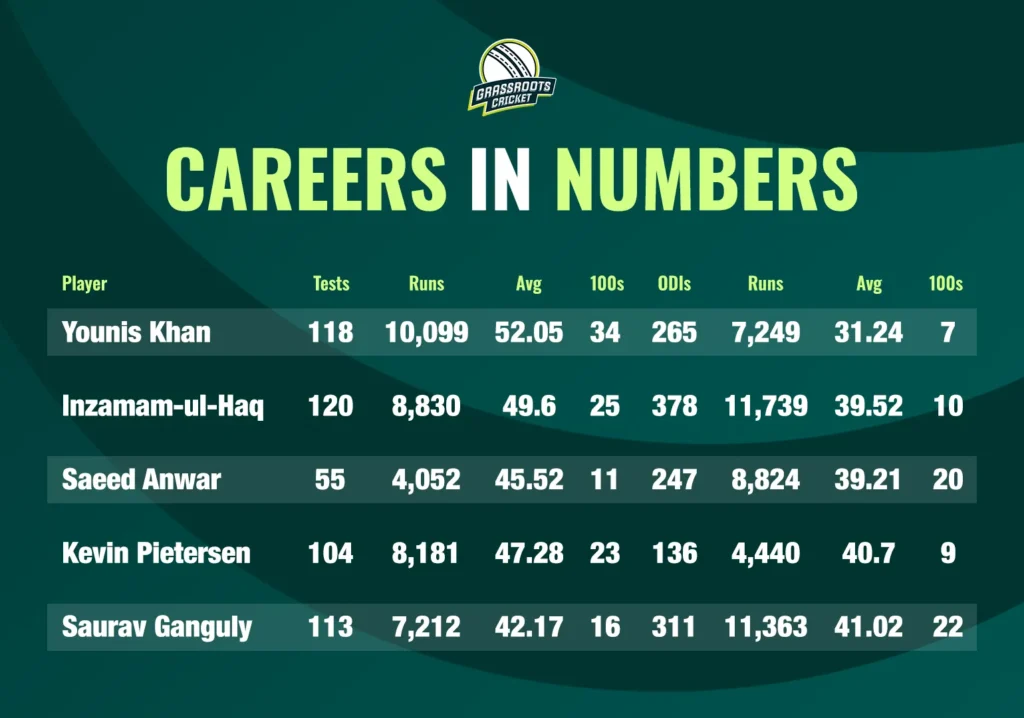
When he retired in 2017, Younis stood alone as Pakistan’s only 10,000-run Test batter, finishing with 10,099 runs from 118 Tests at an average of 52.05 and 34 centuries. Every other Asian batter to have crossed the 10,000-run milestone – Sachin Tendulkar, Rahul Dravid, Sunil Gavaskar, Kumar Sangakkara and Mahela Jayawardene – is already an ICC Hall of Famer.
Younis remains the exception.
His Test average comfortably exceeds Ganguly’s 42.17 and Pietersen’s 47.28, while his 34 Test centuries remain Pakistan’s record.
His most remarkable achievement, however, may be one that rarely receives sufficient attention.
Younis is the only player in Test history to score a century against every opponent he faced. Ganguly never managed one against South Africa or the West Indies. Pietersen never reached three figures against Bangladesh. Younis succeeded against all nine Test nations he encountered, illustrating a level of adaptability unmatched by any other batter.
His greatness extended beyond statistics.
Only weeks after the terrorist attack on the Sri Lankan team in Lahore, Younis captained his country to the ICC Men’s T20 World Cup title in England in 2009. At a time when Pakistan’s cricketing future appeared uncertain, he led the nation to its first ICC trophy in 17 years – one of the most emotionally significant triumphs in its cricketing history.
Saeed Anwar: the opener who redefined possibility
If Younis embodied endurance, Saeed Anwar represented innovation.
Long before attacking opening batters became commonplace in ODI cricket, Saeed demonstrated that classical strokeplay and sustained aggression could coexist.
His unforgettable 194 against India in Chennai in 1997 was not merely Pakistan’s highest ODI score at that time. Equally significant was the opposition. Saeed achieved the feat against India in their backyard rather than a developing cricket nation, giving the innings enduring historical weight.
He retired with 20 ODI centuries from 247 matches – then a Pakistan record – while averaging 39.21 in an era when scoring-rates were significantly lower than today.
Saeed’s Test career deserves equal recognition. In only 55 Tests, he scored 4,052 runs at 45.52, comfortably exceeding Ganguly’s Test average despite playing less than half as many matches. His unbeaten 188 against India at Eden Gardens in 1999 remains one of Pakistan’s finest overseas innings, carrying his bat through the entire innings as only the third Pakistani ever to do so.
Wisden recognised his influence by naming him one of its Cricketers of the Year in 1997.
Saeed Anwar’s elegance made him memorable. His production made him great.
Inzamam-ul-Haq: the batting heartbeat of a generation
If Saeed transformed Pakistan’s one-day opening and Younis became its greatest Test batter, Inzamam-ul-Haq provided the batting stability around which Pakistan built for almost fifteen years.
He retired with more than 20,000 international runs, still the only Pakistani batter to reach that landmark.
In ODIs, his 11,739 runs remain higher than Ganguly’s tally, while his 83 half-centuries were, at the time of his retirement, the most by any player in ODI history — a measure not simply of longevity but of remarkable consistency.
His defining international performances arrived early. As a 22-year-old in the 1992 World Cup, his counter-attacking innings in both the semi-final against New Zealand and the final against England altered Pakistan’s cricketing history and helped secure the country’s first World Cup title.
His Test record is equally compelling: 8,830 runs at 49.60, 25 centuries and a highest score of 329 against New Zealand, still Pakistan’s second-highest individual Test score.
As captain, he guided Pakistan to a landmark Test series victory in India in 2005 — Pakistan’s first there since 1987 — before overseeing a home series victory against England later the same year.
Few players combined longevity, consistency and defining moments as convincingly.
Statistics alone do not guarantee ICC Hall of Fame induction. What strengthens these three cases is that the numbers are reinforced by unique achievements, historical significance and lasting influence.
Younis remains the only batter to score Test centuries against every opponent he faced. Saeed held the highest individual ODI score in history for almost thirteen years. Inzamam retired among cricket’s most prolific run-scorers after anchoring Pakistan’s batting for more than a decade.
Each satisfies a different measure of greatness. Together, they present one of the strongest collective ICC Hall of Fame cases in modern cricket.
None of this diminishes the achievements of Ganguly, Chopra or Pietersen. Their places are fully deserved. Nor is this an argument that the ICC has overlooked Pakistan historically. Hanif Mohammad, Javed Miandad, Imran Khan, Zaheer Abbas, Wasim Akram, Waqar Younis and Abdul Qadir rightly occupy their places in the Hall.
Instead, it is an argument for consistency. The ICC Hall of Fame exists to preserve cricket’s greatest careers, not merely its most celebrated ones.
By every meaningful measure – statistical excellence, historical significance and lasting influence – Younis Khan, Saeed Anwar and Inzamam-ul-Haq belong in that company.
The Class of 2027 offers the ICC an opportunity not to rewrite history, but to recognise it.

GRC Staff
Lorem ipsum dolor sit amet, conse ctetuer adipiscing elit, sed diam nonum nibhie. Aenean sollici tudin, lorem auci elit consequat ipsutis sem niuis sed odio sit amet nibh vulputate cursus.




Leave a Reply