
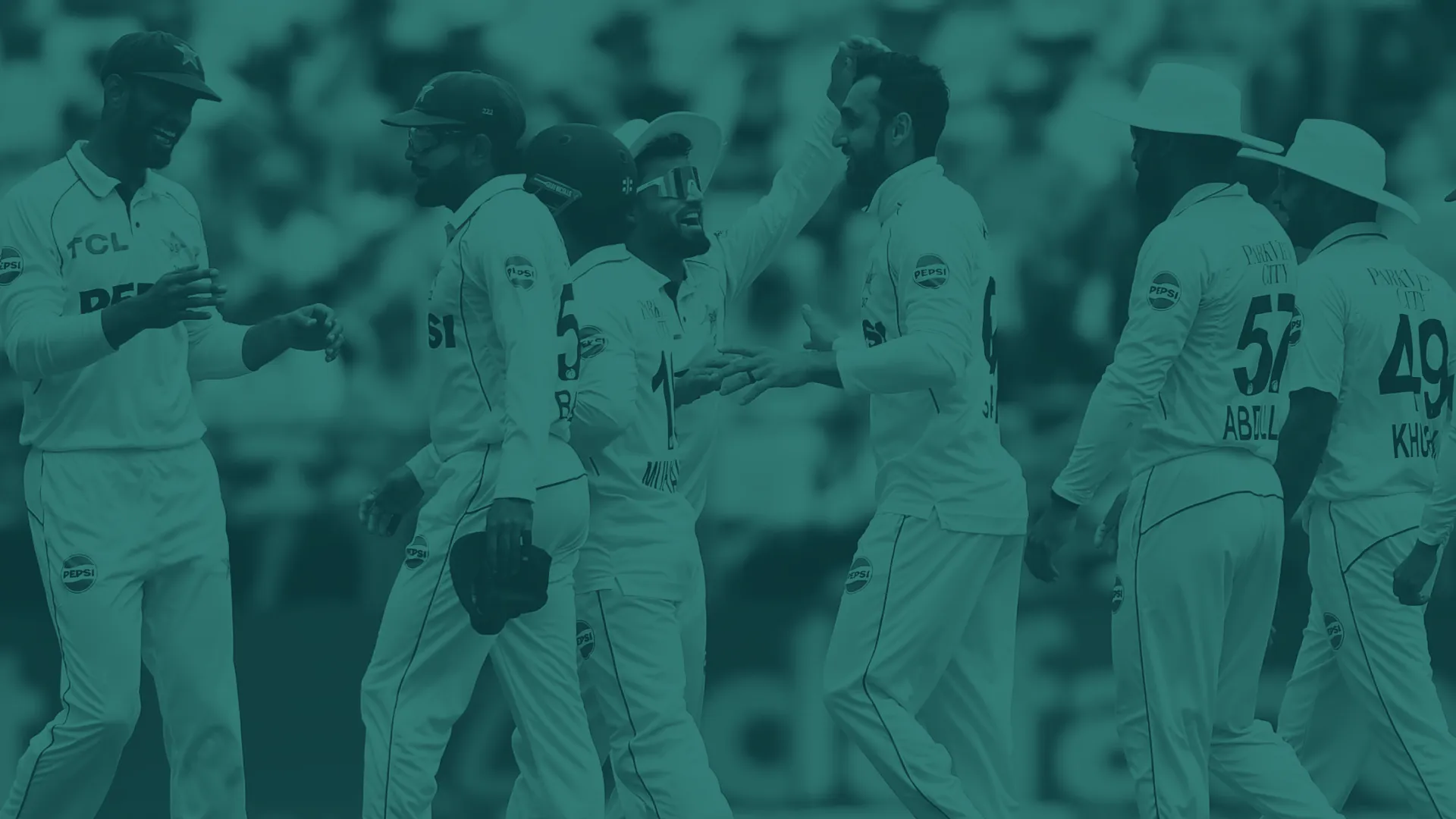
Pakistan Return To Tests With Plenty To Prove
LAHORE: Seven months of dormancy. Seven Tests in four months. The countdown begins in Mirpur on Friday.
Pakistan’s return to Test cricket is not just a homecoming of sorts — it is the opening chapter of arguably the most consequential stretch of red-ball cricket this generation of Pakistani players has faced. When they step onto the field at the Sher-e-Bangla National Cricket Stadium, they carry with them the weight of a format that has, in recent years, exposed every fault line within the team’s structure.
The arithmetic of what lies ahead is stark. From this week through to September, Pakistan must navigate seven Tests — two here in Bangladesh, two in the West Indies, and three against England. But to reduce this sequence to a calendar exercise would be to miss the point.
These seven Tests will determine careers, define a coaching philosophy, and tell us whether Pakistan have genuinely absorbed the lessons of a turbulent 18 months — or simply papered over the cracks.
The ghost of Rawalpindi
No preview of this series can begin anywhere other than August 2024. On home soil, on surfaces doctored to nullify any batting threat, Pakistan lost both Tests against Bangladesh. They were not narrow defeats. They were structural collapses.
In the first Test, Pakistan declared at 448 for six in their first innings — a position of commanding authority — and still lost by 10 wickets. In the second, they reduced Bangladesh to 26 for six before somehow surrendering their own second innings for 81 for six, eventually losing by six wickets. The numbers belong in a catalogue of cricketing disbelief.
Pakistan then salvaged some pride by beating England 2–1 at home on spin-friendly surfaces — though head coach Jason Gillespie himself noted his own role had been reduced to that of a “match day strategist,” hardly a ringing endorsement of the management environment. The wounds from Bangladesh did not heal. They were merely bandaged. Gillespie eventually paid the price, “resigning” as head coach in December.
Now, for the six survivors of that Rawalpindi catastrophe — Shan Masood, Babar Azam, Khurram Shahzad, Mohammad Rizwan, Salman Ali Agha, Saud Shakeel and Shaheen Shah Afridi — this series is a reckoning, not a fixture. Mediocrity in Dhaka and Sylhet could cost them their places before the tours of the Caribbean and England begin.
The rust problem: white-ball rhythms, red-ball demands
Pakistan’s squad is, to put it plainly, ringingly out of practice in Test cricket. Most of the touring party has spent the past seven months in the hyper-condensed rhythms of T20 cricket — the Pakistan Super League, a home T20 series against Australia and Bangladesh, and the ICC Men’s T20 World Cup. At least 10 of the 16 players in the squad have featured in PSL 2026, with Babar Azam, Shan Masood, and Shaheen Shah Afridi all making the Team of the Tournament.
There is genuine value in form and confidence gained in any format. But the mental recalibration required to shift from the aggression and immediacy of franchise T20 cricket to the patience, discipline, and tactical layering of a five-day Test is not trivial — especially when Bangladesh’s bowlers are ready and waiting.
The four notable exceptions to this white-ball immersion are middle-order batter Azan Awais, wicketkeeper Muhammad Ghazi Ghori, left-arm spinner Noman Ali and off-spinner Sajid Khan, have remained closer to red-ball conditions by attending a 13-day red-ball camp at the National Cricket Academy in Lahore. On Bangladesh’s sub-continental tracks, their experience could prove decisive. But seven months without Test exposure for the batting core remains a legitimate concern.
Babar Azam: beyond the PSL runs
Pakistan’s most gifted batter enters this series with 588 PSL runs to his name — enough to top the tournament charts and silence any whispers about white-ball form. But the question that defines Babar’s current Test era is entirely separate: when does the century come?
Thirty Test innings. Four half-centuries. One hundred — back in December 2022, a 161 against New Zealand in Karachi. What was once an astonishing anomaly has become a persistent and uncomfortable reality. Babar Azam, by any measure one of the finest batters of his generation, has not converted in Test cricket for over two years.
The problem is not a lack of starts. It is the inability to translate good positions into match-defining scores — precisely what this series requires. Bangladesh will test him with pace through Nahid Rana’s raw hostility and Taskin Ahmed’s accuracy, before spinning the ball into the rough with Mehidy Hasan Miraz. If Babar goes deep in Mirpur, it matters. If he doesn’t, the questions will grow louder heading into England.
Shaheen’s quiet return
Of the bowling questions, none is more layered than Shaheen Shah Afridi’s. The left-arm quick remains Pakistan’s most potent new-ball threat in conditions that suit pace — but his Test record since the second half of 2024 tells a concerning story. In the five-and-a-half years between his debut in December 2018 and August 2024, Shaheen played 30 Tests in which he took 115 wickets. Since then, he has managed just five wickets in three Tests.
The official explanation centres on a lingering injury sustained during the Sri Lanka tour in early 2024. But the management of a fast bowler of Shaheen’s profile — one who carries genuine match-winning capability across all formats — will be scrutinised carefully in Dhaka.
Bangladesh’s sub-continental pitches may not replicate the swinging conditions of England or the bounce of South Africa, but there is no better place to re-establish rhythm and confidence than in a competitive series with something at stake.
Bangladesh: the confidence of the converted
It would be a fundamental error to frame this series purely through Pakistan’s lens. Bangladesh are in Mirpur not as cautious hosts nervous about the occasion, but as a team that has demonstrably cracked the code of beating Pakistan.
Their bowling attack is built around a complementary three-pronged threat. Nahid Rana has emerged as a genuinely uncomfortable prospect — tall, steep, and capable of finding awkward carry-on home surfaces. Taskin Ahmed brings control and experience at the top of the innings. And Mehidy Hasan Miraz remains perhaps their most dangerous weapon across conditions, capable of strangling batters with offspin while contributing useful runs down the order. Between these three, they shared 20 wickets in the 2024 series — the blueprint is set.
Captain Najmul Hossain Shanto leads a settled batting unit featuring the experience of Mushfiqur Rahim, Mominul Haque, and the technically sound Shadman Islam. Bangladesh will not be awed by Pakistan’s reputation. They have already dismantled it once.
Sarfaraz: a new role, an unfamiliar test
Pakistan’s new head coach Sarfaraz Ahmed arrives in the role via an unconventional route — fast-tracked through the U19 set-up as manager and mentor earlier this year before taking the top job. As a captain, Sarfaraz was combative, instinctive, and capable of extracting performances from seemingly impossible situations. As a coach, those same qualities are yet to be tested at the senior level.
His stated ambition — to guide Pakistan to the ICC World Test Championship 2025-27 final at Lord’s in July 2027 — is bold but not implausible, provided the next seven Tests establish a clear direction. The WTC cycle demands results, not potential. Sarfaraz’s real test is whether he can impose structure, accountability, and consistency on a squad that has shown, at various points, all three of those qualities — but rarely simultaneously.
The bigger picture
Zoom out from the series itself, and Pakistan’s Test decade makes for uncomfortable reading. Since 2020, they have played 17 series, won five, and lost seven. Since December 2023 alone, the record reads: three draws, three losses, one win. For a side that counts some of the world’s most naturally talented cricketers, there is a stubborn gap between resource and result.
The upcoming seven Tests — starting in Mirpur on Friday — represent the clearest opportunity in some time to rewrite that narrative. Bangladesh will be formidable on home soil. The West Indies will test Pakistan’s batting in bouncy conditions. England, in English summer, will be the most demanding examination of all.
But it starts here. With a series that already has history behind it, and careers on the line in front of it, Pakistan cannot afford another ghost to add to the one from Rawalpindi.
SQUADS:
Pakistan Test squad: Shan Masood (c), Abdullah Fazal, Amad Butt, Azan Awais, Babar Azam, Hasan Ali, Imam-ul-Haq, Khurram Shahzad, Mohammad Abbas, Mohammad Rizwan (wk), Muhammad Ghazi Ghori (wk), Noman Ali, Sajid Khan, Salman Agha, Saud Shakeel, Shaheen Shah Afridi.
Bangladesh squad (1st Test): Najmul Hossain Shanto (c), Mahmudul Hasan Joy, Shadman Islam, Mominul Haque, Mushfiqur Rahim, Litton Das, Mehidy Hasan Miraz, Taijul Islam, Nayeem Hasan, Ebadot Hossain, Shoriful Islam, Taskin Ahmed, Nahid Rana, Tanzid Hasan, Amite Hasan.

GRC Staff
Lorem ipsum dolor sit amet, conse ctetuer adipiscing elit, sed diam nonum nibhie. Aenean sollici tudin, lorem auci elit consequat ipsutis sem niuis sed odio sit amet nibh vulputate cursus.




Leave a Reply