

Pakistan Enter Edgbaston With Everything at Stake
Pakistan will enter Edgbaston on Wednesday carrying a burden far heavier than the need to avoid a 3-0 series defeat. After two emphatic losses to England — by an innings and 103 runs at Headingley and by 194 runs at Lord’s — Pakistan’s cricket has descended into a crisis that extends well beyond results.
The team has been reshaped, the coaching staff changed and seven players sent home midway through the tour.
What should have been the final Test of a difficult series has instead become an examination of Pakistan cricket’s leadership, governance and ability to function under pressure.
The upheaval began within hours of the Lord’s defeat. Mohammad Rizwan, Imam-ul-Haq, Salman Ali Agha, Ali Usman, Aamir Jamal, Muhammad Awais Zafar and Khurram Shahzad were released from the squad, while head coach Sarfaraz Ahmed and bowling coach Umar Gul were also removed.
The PCB provided little explanation when announcing the changes, replacing the departing players with seven additions, including five players yet to play Test cricket. Mike Hesson and Ashley Noffke were installed as interim head and bowling coaches respectively.
The scale and timing of the changes have drawn widespread criticism, with former Pakistan coach Jason Gillespie among those questioning the manner in which the overhaul was conducted. Reuters reported that Gillespie criticised the board’s lack of stability and professionalism, pointing to Pakistan having had six Test coaches in three years.
The crisis deepened when Aqib Javed, the PCB’s high-performance director, attempted to explain the decision-making process surrounding the Lord’s Test. In a television interview, he said he had told Sarfaraz to play either Aamir Jamal or Ubaid Shah and suggested that, after that advice was not followed, “someone had to take the decision”.
That immediately raised questions about the chain of command within Pakistan’s cricket structure and the extent to which decisions were being made remotely while the team was in England.
The timing was particularly awkward because Aqib and fellow selectors Asad Shafiq, Misbah-ul-Haq and Sarfaraz had themselves subsequently been asked by the PCB to explain the selection of Imam and Rizwan. Misbah then departed his position as a selector, further exposing the instability surrounding a selection process that had already come under intense scrutiny.
PCB chairman Mohsin Naqvi subsequently entered the discussion, saying that events “outside cricket” had contributed to the dramatic decisions. That remark, rather than settling the controversy, created another layer of speculation around what had happened inside the Pakistan camp.
The PCB has since announced an internal investigation into reports concerning player discipline and conduct. However, the board has not publicly detailed the specific allegations being investigated, leaving considerable room for speculation and further confusion.
Hesson, meanwhile, has made clear that he was not involved in the decisions to release the senior players, because those decisions had already been made before he took charge. He has instead been left to prepare a radically altered side for a Test that, only days earlier, would have been expected to feature largely the same group that began the series.
That leaves Pakistan arriving in Birmingham with a squad that is difficult to recognise.
Four players who featured at Lord’s — Ali Usman, Imam, Rizwan and Khurram Shahzad — have gone home, while Aamir Jamal, Awais Zafar and Salman Ali Agha, who were left out of the XI, have also been released.
In their places are players with vastly different levels of experience. Abdullah Fazal has played two Tests and Saim Ayub eight, while the remainder of the replacements have no Test experience.
Hesson has indicated that Pakistan could field four specialist seamers, potentially bringing Ubaid Shah into an attack alongside Mohammad Ali and Mohammad Abbas. Ghazi Ghori is in line for a Test debut behind the stumps, while the opening combination remains one of the biggest questions.
Azan Awais, who made 46 in the first innings at Lord’s, has endured a difficult tour otherwise, creating the possibility of another change at the top of the order. Abdullah Fazal and Saim Ayub could form an entirely new opening pair.
It is a remarkable situation. Abdullah Fazal had been ruled out of Pakistan’s previous Test assignments in the Caribbean and England after suffering an injury, while Saim’s return to the Test side comes after a long absence that followed his injury in Cape Town in January 2025.
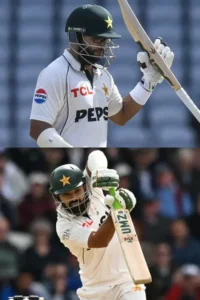
And amid all the uncertainty sits Babar Azam.
Pakistan’s captain missed the Headingley Test with injury before returning at Lord’s, where he scored only eight and six as England’s pace attack repeatedly exposed Pakistan’s fragile batting.
Babar has produced flashes of the quality that has made him one of Pakistan’s most important players, but his Test batting has become an increasingly uncomfortable subject. His last Test century came in December 2023, and although he came close in the Caribbean earlier this summer — scoring 86 in the second Test against West Indies — he has continued to search for the big innings expected of him.
Against England, the challenge is particularly severe. Jofra Archer, Ollie Robinson, Josh Tongue and Gus Atkinson have found ways to challenge Pakistan’s batters with pace, movement and bounce, while England’s attack has repeatedly exploited technical and mental weaknesses.
Babar has produced flashes of the quality that has made him one of Pakistan’s most important players, but his Test batting has become an increasingly uncomfortable subject. His last Test century came in December 2023, and although he came close in the Caribbean earlier this summer — scoring 86 in the second Test against West Indies — he has continued to search for the big innings expected of him.
Against England, the challenge is particularly severe. Jofra Archer, Ollie Robinson, Josh Tongue and Gus Atkinson have found ways to challenge Pakistan’s batters with pace, movement and bounce, while England’s attack has repeatedly exploited technical and mental weaknesses.
Babar, therefore, enters Edgbaston under pressure not simply as captain, but as the most recognisable figure in a batting line-up that has failed to produce an innings of 200 in either Test.
Yet it would be profoundly simplistic to make Babar the central explanation for Pakistan’s collapse.
The greater question is why a team can lose two Tests, undergo a wholesale mid-series restructuring and then be expected to immediately rediscover confidence, cohesion and performance.
Cricket teams are built on trust. Players need to know their roles, understand the selection process and believe that poor performances will be addressed through a coherent plan rather than abrupt reaction.
Pakistan have spent the past week confronting almost the opposite.
Players have been removed. Coaches have been replaced. Selectors have come under scrutiny. A senior selector has departed. An investigation into discipline has been announced. Public explanations have produced further questions rather than answers.
And all of this has happened while the players remain thousands of miles from home, preparing for another Test against an England side that has already secured the series and now has the opportunity to complete a 3-0 sweep.
The expectation that 11 players can simply walk into Edgbaston, put the turmoil behind them and produce a statement victory is therefore unrealistic.
They can, of course, win. Sport routinely defies expectation. But asking this group to perform under such circumstances is very different from asking a stable, settled team to respond to a poor result.
The most damaging consequence of the past week may not be what happens at Edgbaston. It may be what happens the next time a Pakistan player walks into an international dressing room after a defeat and wonders what the consequences will be.
Confidence, trust and respect are not administrative luxuries. They are foundations of high-performance sport. Pakistan have spent much of the past week damaging all three.
That is why the bigger question at Edgbaston is not whether Babar can rescue his career, whether Ghazi Ghori can make a successful debut or whether a new-look Pakistan attack can trouble England. It is whether the PCB can eventually demonstrate that there is a coherent plan beyond reacting to the latest defeat.
England have already won the series. Pakistan are playing for pride, reputation and the avoidance of a whitewash.
But beyond the five days at Edgbaston lies a much larger examination.
The PCB must explain its decisions, establish accountability within its own structures and restore confidence in a national team that has been repeatedly subjected to upheaval.
Players will walk out on Wednesday carrying the consequences of decisions made above them. The result may determine the series’ scoreline. What happens after it may determine the direction of Pakistan cricket.
Pakistan squad: Babar Azam (c), Abdullah Fazal, Abdullah Shafique, Arafat Minhas, Azan Awais, Mohammad Abbas, Mohammad Ali, Muhammad Imran, Mohammad Imran Jnr, Muhammad Ghazi Ghori, Razaullah, Saad Baig, Saim Ayub, Sajid Khan, Saud Shakeel, Shan Masood, Ubaid Shah.
England squad: Joe Root (c), Jofra Archer, Gus Atkinson, Sonny Baker, Shoaib Bashir, Harry Brook, Sam Cook, Jordan Cox, Ben Duckett, Emilio Gay, Dan Lawrence, Ollie Pope, Ollie Robinson, Jamie Smith, Josh Tongue.
England lead the series 2-0.
Pakistan captain Babar Azam's pre-match press conference | Pakistan vs England, 3rd Test#ENGvPAK | #PakistanCricket pic.twitter.com/bZA9aa07g6
— PCB Media (@TheRealPCBMedia) September 8, 2026

GRC Staff
Lorem ipsum dolor sit amet, conse ctetuer adipiscing elit, sed diam nonum nibhie. Aenean sollici tudin, lorem auci elit consequat ipsutis sem niuis sed odio sit amet nibh vulputate cursus.


Leave a Reply