
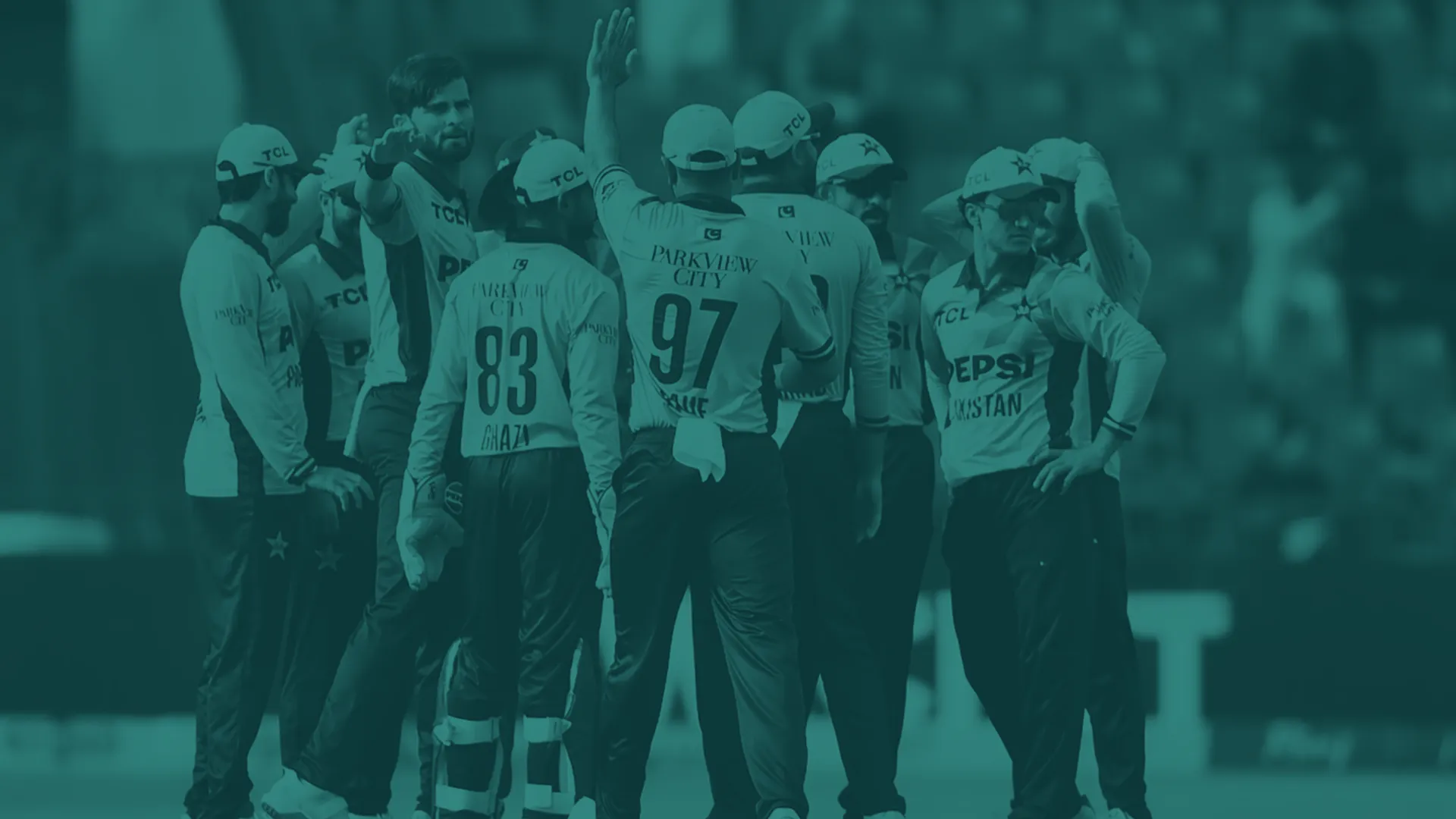
ODI World Cup Clock Ticking: is Pakistan Really Ready?
Qualification is secured. That is one box Pakistan will not have to worry about ticking as the countdown to the ICC Men’s Cricket World Cup 2027 gathers pace.
The more uncomfortable question is what happens after they get there.
With just over 12 months remaining before the World Cup begins in South Africa, Zimbabwe and Namibia, the leading contenders have started shifting their focus towards the 50-over format. For Pakistan, the next year represents an opportunity to establish the stability, clarity and continuity that have too often been missing from their ODI cricket.
Their recent World Cup record makes the task particularly significant.
Semi-finalists in 2011 and quarter-finalists in 2015, Pakistan failed to reach the knockout stages in both 2019 and 2023. Sixteen years will therefore have passed since their last World Cup semi-final by the time the 2027 tournament begins.
For the 1992 champions and a country that considers itself one of cricket’s major forces, that is an uncomfortable trend.
More concerning is that while several principal rivals appear to be moving towards identifiable combinations, Pakistan still have questions virtually everywhere.
Who are the automatic selections? What is the preferred batting order? What is the best balance of the attack for southern African conditions? Who finishes an innings? And, above all, will there be continuity in leadership, selection and coaching over the next 12 months?
Even the captaincy invites discussion.
Shaheen Shah Afridi is Pakistan’s designated ODI captain. Yet recent history makes long-term assumptions hazardous. Pakistan cricket has experienced repeated changes in leadership, selection structures and team management. The issue, therefore, is not merely who holds the captaincy today, but whether the same leadership structure will be allowed to develop all the way to the World Cup.
White-ball head coach Mike Hesson is presently occupied with Pakistan’s T20I squad at the Asian Games. Again, that in itself is hardly a problem. The larger requirement is a clearly defined ODI programme in which captain, coach, selectors and players are working towards the same World Cup blueprint.
The clock has started.
NINE ODIs — ENOUGH IF USED PROPERLY
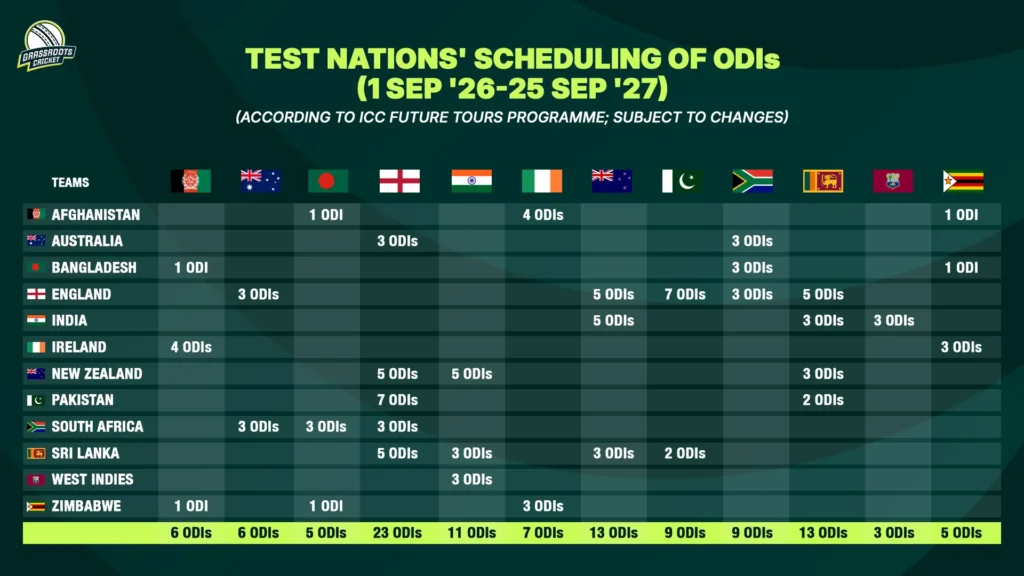
According to the current schedule, Pakistan are guaranteed nine ODIs between September 1, 2026 and September 25, 2027 — four in next month’s home tri-series against England and Sri Lanka and five in England next May. A place in the tri-series final would increase that number to 10.
By comparison, England currently have 23 ODIs scheduled during the same period, New Zealand and Sri Lanka 13 each, India 11, Australia and South Africa nine apiece, Ireland seven, Afghanistan six, Bangladesh five, West Indies three and Zimbabwe eight.
The Future Tours Programme remains subject to change and boards can add matches as their World Cup preparations develop. But the figures make an important point: Pakistan cannot simply blame a shortage of ODI cricket.
Nine or 10 matches should provide enough information to establish the core of a World Cup squad. What Pakistan cannot afford is to reach the final few months still using bilateral series to answer fundamental questions about captaincy, personnel and roles.
Every ODI now needs a purpose.
Pakistan’s preparations effectively begin next month when they host England and Sri Lanka in a tri-nation series. It should be treated as considerably more than another home assignment.
It is the beginning of the World Cup audition.
Pakistan have played six ODIs in 2026, winning three and losing three. The record itself is neither disastrous nor particularly reassuring. More important is how much closer those matches have taken Pakistan towards identifying the side they expect to field in southern Africa.
There are still places available, which can be healthy 12 months before a World Cup. Competition should sharpen a team. But there is a significant difference between competition for two or three positions in an otherwise settled side and uncertainty running through the structure of the team.
Pakistan need to move rapidly towards the former.
RIVALS APPEAR FURTHER DOWN THE ROAD
The significance of the current ODI window can be seen elsewhere.
Australia, the defending world champions, have been particularly deliberate. Six of their nine ODIs in the period covered by the schedule are being played this month in Zimbabwe and South Africa — two of the three countries that will stage the World Cup.
They played three matches in Zimbabwe before moving to South Africa for another three, giving their players valuable early exposure to conditions they will encounter when they defend their title next year.
South Africa have experienced players around whom they can construct their World Cup side, while India and England possess substantial pools of established white-ball cricketers. Recent performances suggest all four already have many of the fundamental components of their World Cup combinations in place.
That guarantees nothing in October 2027. Form disappears, injuries intervene and previously settled combinations can unravel.
But stability matters because it allows teams to spend the final year refining rather than rebuilding.
Pakistan need to reach that stage quickly.
QUALIFICATION REMOVES ONE HEADACHE
At least Pakistan can plan without the anxiety of having to fight their way through the qualifying tournament.
South Africa and Zimbabwe qualify automatically as Full Member hosts, while Pakistan have secured direct qualification alongside India, New Zealand, Australia, Sri Lanka, England, Afghanistan and Bangladesh.
That means the next year can be devoted entirely to building a team capable of progressing deep into the tournament rather than worrying about whether Pakistan will be there.
But qualification and contention are very different standards.
Simply reaching the World Cup was never supposed to represent success for Pakistan. The objective has to be arriving in southern Africa with a side capable of challenging for the title.
The challenge is considerable. The expanded 14-team competition will demand consistency over a long tournament before the eventual champions are crowned.
A team hoping to win the World Cup will need more than one inspired afternoon. It will have to repeatedly perform under pressure.
BUILD FOR AFRICAN CONDITIONS
The location of the tournament should influence Pakistan’s planning immediately. Conditions across South Africa, Zimbabwe and Namibia will vary, but pace, bounce, adaptability and athleticism are likely to assume considerable importance.
Pakistan therefore need to determine not only their best players, but their best combination for those conditions.
Shaheen should theoretically be central to that equation, but Pakistan must establish the attack around him. They need fast bowlers capable of taking wickets with the new ball without surrendering control later in the innings, spin options suited to different surfaces and a batting order capable of surviving high-quality pace while still producing the acceleration modern ODI cricket demands.
Above everything else, roles have to become unmistakable.
Players should enter an ODI knowing why they have been selected, where they bat, what phase they are expected to control and what they need to do to remain part of the World Cup plan.
Selection cannot become a revolving door.
TWELVE MONTHS CANNOT BECOME ANOTHER EXPERIMENT
Pakistan cricket has rarely lacked talent. Its recurring difficulty has been converting that talent into a stable, coherent international side.
That makes the next 12 months as much an administrative challenge as a cricketing one.
Selectors cannot react dramatically to every individual performance. The team management needs sufficient continuity to implement a plan. The captain needs to know where he stands. Players need clearly defined roles.
There will inevitably be changes. Someone outside today’s preferred squad will force his way in. An established player may lose form. Injuries will alter combinations.
That is normal preparation. Continually changing the plan itself is not.
Pakistan have nine guaranteed ODIs in which to transform uncertainty into clarity. By the final five or six matches, the discussion should no longer revolve around finding a captain, discovering half a batting order or identifying the core bowling attack.
Those games should be about refining combinations, examining alternatives and preparing specific players for specific situations.
That is what the final months before a World Cup are for.
PAKISTAN ARE GOING — BUT IN WHAT SHAPE?
For once, the qualification equation offers Pakistan some comfort. They know they will be in southern Africa.
What nobody knows yet is what sort of Pakistan team will arrive there.
Will it be a settled side hardened by a year of purposeful ODI cricket, with an established captain, clearly defined roles and a management structure pulling in one direction?
Or will Pakistan reach another World Cup still debating combinations, leadership and selection?
England currently have 23 scheduled ODIs in which to prepare. New Zealand and Sri Lanka have 13 each, India 11, while Australia and South Africa have nine apiece.
The numbers themselves will not determine who lifts the trophy.
What teams do with those matches might.
Pakistan have enough cricket to build a competitive World Cup side. They have enough talent to assemble one. And with direct qualification secured, they have the luxury of concentrating entirely on preparation.
What they no longer have is time to waste.
Twelve months out, Pakistan’s biggest World Cup opponent may not be India, Australia, England or South Africa. It is uncertainty.

GRC Staff
Lorem ipsum dolor sit amet, conse ctetuer adipiscing elit, sed diam nonum nibhie. Aenean sollici tudin, lorem auci elit consequat ipsutis sem niuis sed odio sit amet nibh vulputate cursus.




Leave a Reply