

Is Shan Masood The Problem – Or The Symptom?
Pakistan have now lost four consecutive Tests to Bangladesh across two series and two countries. The calls for Shan Masood’s removal as captain are growing louder and, on the surface, understandable.
Twelve defeats in 16 Tests. Four wins. On numbers alone, it is one of the poorest captaincy records in Pakistan’s Test history.
But numbers without context can mislead. The environment surrounding Shan’s captaincy has been so unstable and fragmented that reducing Pakistan’s decline to one individual risks ignoring the deeper failures that created it.
This is not a defence of Shan Masood. It is an attempt to look at the broader picture.
Five coaches in 16 Tests
In just 16 Tests as captain, Shan has worked under five different head coaches.
Mohammad Hafeez oversaw the Australia tour. Jason Gillespie handled the home series against Bangladesh and England. Aqib Javed replaced him for South Africa away and the West Indies at home. Azhar Mahmood then arrived for the home South Africa series, before Sarfaraz Ahmed took charge. Five coaches, sixteen Tests!
Every coaching change brings new ideas, tactical priorities and player relationships. Under such conditions, expecting a captain to build continuity, establish culture or implement a long-term strategy is unrealistic.
Compare that to Misbah-ul-Haq, Pakistan’s most successful Test captain with 26 wins in 56 matches. Misbah worked largely under Dave Whatmore and Mickey Arthur and was backed long enough for his methods to take hold. The stability behind that success was structural, not accidental.
That raises an uncomfortable question: has Shan been given a fair opportunity to succeed?
A selection system without continuity
The instability has extended beyond coaching.
During Shan’s tenure, nearly a dozen former cricketers have rotated through Pakistan’s selection committee, which has operated without a permanent chair for over two years.
Nine players made Test debuts under Shan. Several disappeared almost immediately. Kamran Ghulam scored a century on debut against England and was dropped. Asif Afridi took six wickets in his only Test against South Africa and was discarded.
Pakistan also used six different opening combinations before the Bangladesh series, cycling through Abdullah Shafique, Imam-ul-Haq, Saim Ayub, Shan himself, Babar Azam and Mohammad Huraira.
This was not continuity. It was constant improvisation.
Shan himself has long been a product of that same inconsistency. Since debuting in October 2013 in Abu Dhabi, he has played only 46 of Pakistan’s 93 Tests. A player of his technical ability should, in a more stable system, have accumulated far more than 2,653 Test runs.
Instead, his career has followed a familiar Pakistan pattern: picked, dropped, recalled and dropped again. By the time he became captain, he was still rebuilding his own place in the side.
To the PCB’s credit, the board has resisted the familiar impulse to remove him immediately despite pressure from fans, media and former players. Whether that reflects genuine belief in Shan’s leadership or simply a lack of alternatives is unclear, but the restraint itself is notable in Pakistan cricket.
Congested cricket calendar
The 2025-26 Pakistan cricket calendar highlights the underlying problem.
Between August 2025 and April 2026, Pakistan’s players moved through six domestic competitions in seven months: the Hanif Mohammad Trophy, Quaid-e-Azam Trophy, President’s One-Day Tournament, President’s Trophy, National T20 Cup and Pakistan Super League.
Also running concurrently was international cricket when Pakistan hosted South Africa for a Test series in October and subsequently featured in white-ball series against Sri Lanka (home and away), tri-nation T20I series, Australia, ICC Men’s T20 World Cup and Bangladesh. Not to forget the various training camps.
The result was predictable. Players arrived in Bangladesh fatigued and underprepared for red-ball cricket.
The seven-month gap between Pakistan’s previous Test in Rawalpindi and Mirpur was not a period of rest or focused preparation. It was continuous cricket in other formats.
Babar Azam’s knee injury did not emerge in isolation. Shaheen Shah Afridi — Pakistan’s premier fast bowler, with 116 wickets in 31 Tests between 2018 and 2024 — has managed only 10 wickets in his last four Tests while also seeing his appearances reduced through injury concerns and workload management.
Naseem Shah, who became the youngest bowler to take a Test hat-trick when he achieved the feat against Bangladesh in only his fourth Test in February 2020, has not played a Test since the Boxing Day Test against South Africa in 2024. He has taken 60 wickets in 20 Tests.
When a side enters a demanding overseas cycle carrying fatigue, injuries, insufficient red-ball preparation and inconsistent selections, the consequences should not be surprising.
And Bangladesh was supposed to be the easier part of the schedule.
What Shan is responsible for
None of this absolves Shan Masood.
His captaincy, particularly in Sylhet, has once again come under the microscope after he allowed Bangladesh to recover from 116 for six to 278 in the first innings and from 272 for six to 390 in the second innings. In Rawalpindi in August 2024 against the same opposition, Pakistan had lost the first Test by 10 wickets, declaring their first innings at 448 for six, and then lost the second Test by six wickets after Bangladesh had slipped to 26 for six in the first innings.
Shan’s DRS management has repeatedly hurt Pakistan. Critical reviews were missed in Bangladesh — most notably Litton Das on 52 in Sylhet — while others were poorly judged. The captain makes the final call, and the pattern has become too consistent to ignore.
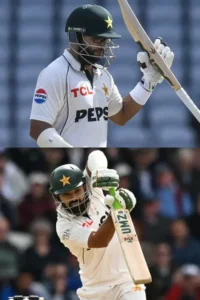
His batting has also failed to provide the leadership example Pakistan needed. His scores in Bangladesh — nine and two in Mirpur, followed by 21 and 71 in Sylhet — were not the contributions of a captain setting a high standard. As captain, he has scored 1,056 runs at 34.
More significantly, Shan has opened the batting in only two of his 16 Tests as captain despite owning a relatively better record as an opener, where he has scored 1,576 runs in 54 innings (5×100, 6×50) compared to 1,003 at number three in 30 innings (1×100, 8×50).
The defining moment of his captaincy in Sylhet came before the match even began.
Azan Awais had scored a century on debut in Mirpur, while Abdullah Fazal made 60 and 68 at number three. Shan had a clear option: move himself to the top of the order alongside Azan and allow Fazal to continue in the role where he had already succeeded. Instead, Shan retained number three for himself and sent two inexperienced players to open together against Nahid Rana, Taskin Ahmed and Shoriful Islam in a must-win Test.
There is also the question of authority. If Shan lacked influence over selections, that reflects systemic dysfunction — but also a failure to impose himself within the structure around him.
Leadership is not only about the conditions you inherit. It is about how strongly you respond to them.
What comes next
The broader concern for Pakistan cricket is that Bangladesh is unlikely to be the lowest point of this cycle.
The West Indies will test Pakistan’s batters against pace and bounce in difficult conditions. England — at Lord’s, Edgbaston and Headingley — will demand a level of technical discipline and mental resilience this batting order has not yet shown.
Pakistan entered this seven-Test overseas stretch hoping to reach the ICC World Test Championship 2025-27 final at Lord’s. That ambition is now effectively over. What remains are five Tests that will shape careers, reputations and the future direction of Pakistan’s Test side.
A batting order collapsing under pressure will not suddenly rediscover certainty in Bridgetown or Birmingham. A selection structure lacking continuity will not suddenly become coherent under greater pressure.
These are not isolated failures. They are the cumulative consequences of prolonged instability.
The verdict
The case against Shan Masood as Test captain is real. Twelve defeats in 16 matches cannot simply be dismissed through context. But the case against the system around him is equally strong and far less frequently acknowledged.
The revolving coaches, unstable selection process, congested cricket calendar and inconsistent team management structure are not excuses for Pakistan’s failures. They are central causes of them.
Pakistan cricket has long searched for individual scapegoats to explain institutional decline. Shan Masood may yet become the latest. But unless the underlying instability is addressed, replacing him will simply hand the same problems to the next captain.
Changing the captain without fixing the system is not accountability. It is repetition.

GRC Staff
Lorem ipsum dolor sit amet, conse ctetuer adipiscing elit, sed diam nonum nibhie. Aenean sollici tudin, lorem auci elit consequat ipsutis sem niuis sed odio sit amet nibh vulputate cursus.



Leave a Reply