
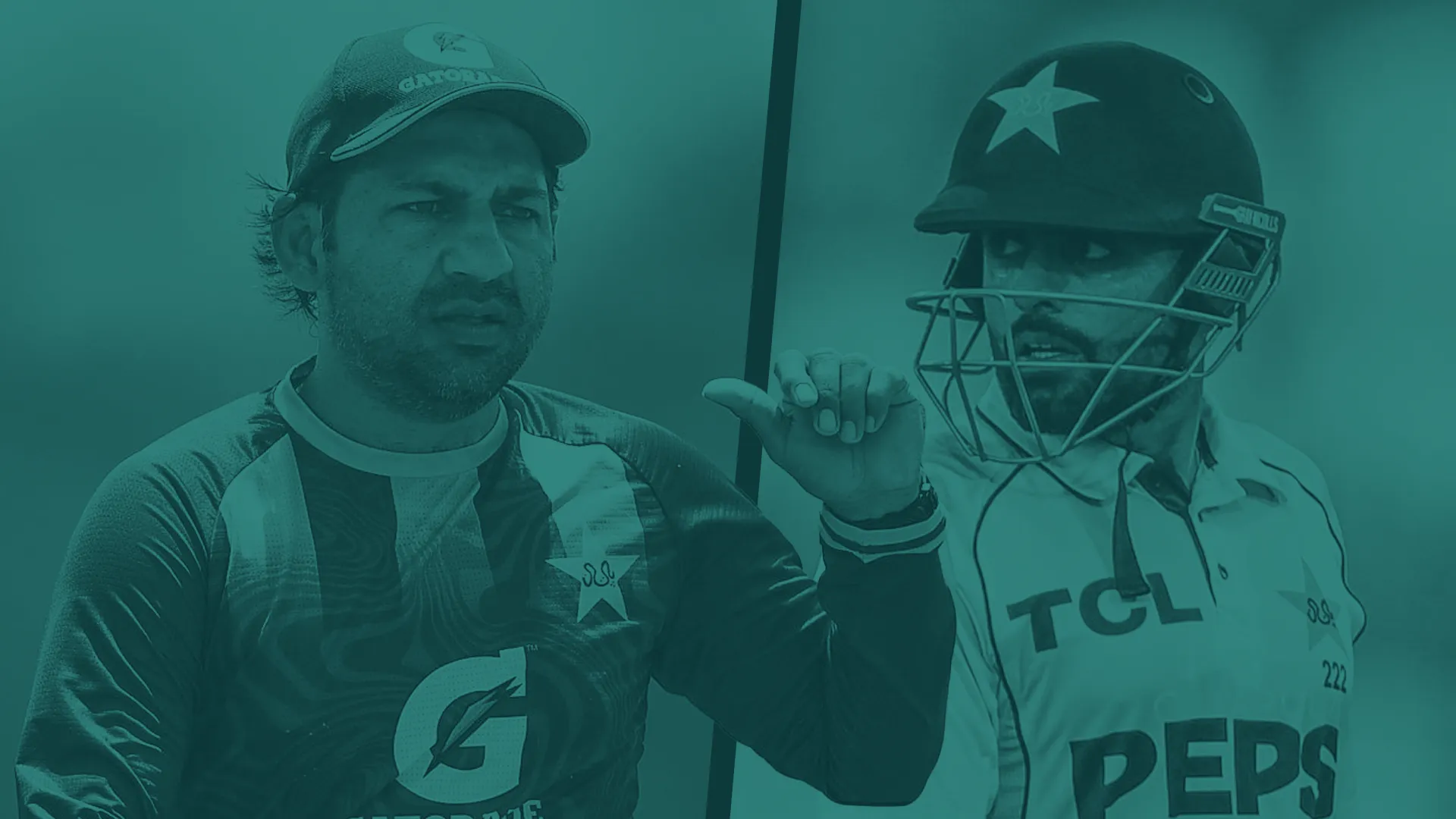
Babar and Sarfaraz: Convenience, or a Masterstroke?
The Pakistan Cricket Board’s latest move feels less like a desperate throw of the dice and more like a calculated script of poetic justice. Last week, Babar Azam was reappointed Pakistan’s Test captain – his second tenure leading the red-ball side. His return coincides with a poignant administrative shift: Sarfaraz Ahmed, the battle-hardened veteran, has been handed the reins as head coach, a journey that began during May’s bruising tour of Bangladesh.
In the wild, lions hunt in pairs and prides for a reason: the odds of success multiply when trust is already built in. Pakistan cricket, for all its chaos, may have just rediscovered that principle by accident.
Babar is no stranger to the board’s erratic leadership cycles, or to the outright disrespect that has often come with them. After being forced to step down as all-format captain following the 2023 World Cup, he was reinstated as T20I captain in March 2024, only for that tenure to last barely six months. The chaos extended into his core competency, red-ball cricket, where the selection committee dropped him for the second and third Tests against England later that year — only to recall him for the South Africa tour that followed. He was subsequently left out of the T20I side for a period, before being recalled for the home series against South Africa and Australia, and selected for the ICC Men’s T20 World Cup 2026. However, he was ultimately left out of the final match against Sri Lanka.
The indignity has, at times, felt personal. During his Karachi Kings days in the PSL, Babar was publicly criticised by a figure with selection influence, who suggested on television, remarkably, that opposing teams preferred to keep him at the crease rather than dismiss him.
Despite surviving this administrative incompetence and public mockery, Babar is now tasked with salvaging the purest format of the game for a team sitting ninth of nine in the World Test Championship 2025-27 and ranked a mediocre seventh in the world.
Yet what cynics will dismiss as a marriage of convenience might actually be the most logically sound, structurally necessary partnership Pakistan cricket has assembled in a decade.
The Student, the Master, and the Reversed Roles
To understand why this pairing has real potential, look back to the start of Babar’s international career. Of the 100 international matches Sarfaraz captained, Babar was in the side for 88 of them — a relationship built on trust, in which Sarfaraz shielded, nurtured and believed in the young batter well before the rest of the world caught on.
Years later, when the roles reversed, Babar returned that loyalty in kind. Amid real external pressure to move Sarfaraz out of the team setup, Babar insisted on keeping him as Pakistan’s designated second wicketkeeper across all formats, right up until the 2023 World Cup.
Now, the roles have reversed again, and poetically so. The student is the on-field commander; the master is the strategic architect in the dugout. It is, in effect, the same pair hunting the same ground – only this time each knows exactly where the other will move.
In the sport’s history, the great captain-coach partnerships — John Buchanan and Ricky Ponting, Ravi Shastri and Virat Kohli, Brendon McCullum and Ben Stokes — were all defined by one thing above tactics or resources: absolute trust, built over years before it was ever tested under pressure. Sarfaraz and Mickey Arthur belong in that conversation too, on a smaller scale — their partnership delivered the 2017 Champions Trophy, still the high-water mark of Pakistan’s white-ball era.
Babar and Sarfaraz do not need to build that trust from scratch. It is already woven into the fabric of their shared history — the rarest asset any new captain-coach pairing can inherit.
The Shaheen Sidelining: A Tactical Quarantine
Perhaps the most consequential development of this new era is an omission. Shaheen Shah Afridi has been left out of the squad for the coming five-Test cycle against the West Indies and England.
On paper, that’s a damning indictment of his declining red-ball potency, and of the PCB’s erratic handling of its prime assets. The board’s game of captaincy musical chairs — handing the T20I reins to Shaheen after 2023, only to strip them back for Babar’s brief return in 2024 — fractured what had once looked like an unbreakable partnership of its own.
The resulting tension threatened, in miniature, to echo the toxic rivalry of Wasim Akram and Waqar Younis in the mid-1990s, when two generational talents spent years looking over their shoulders instead of at the opposition.
But in Shaheen’s absence, Babar has been handed an opportunity. With a competing focal point of authority removed from the dressing room, the PCB has – likely by accident – gifted Babar a tactical quarantine.
On the demanding pitches of the Caribbean and England, he can lead without a leadership proxy war playing out in the background. It gives him and Sarfaraz a genuine clean slate on which to rebuild a fractured team culture from the ground up.
Scapegoats and the Selectors’ Hypocrisy
The reunion of Babar and Sarfaraz is a compelling narrative, but it shouldn’t shield the PCB administration from scrutiny. The timing of Shan Masood’s removal was egregiously delayed.
When they finally axed Masood last week, selectors were quick to list his tactical shortcomings – poor over-rates, erratic DRS calls, no killer instinct to close out tight games. But if these flaws were so obvious, why was Masood allowed to steer the team through a humiliating series defeat to Bangladesh in May before anything changed?
His captaincy had, in truth, run its course after the South Africa tour in December 2024/January 2025. By delaying the inevitable, the selectors let a culture of defeatism take root – proof, once again, that in Pakistan cricket it is always the players and coaches who pay for the administrators’ lack of foresight.
The Path to Revival
The recommended action: the PCB must unconditionally guarantee that the Babar-Sarfaraz partnership runs through to the end of the next WTC cycle, in 2029.
The pitfall to avoid: treating the coming five Tests in the West Indies and England as an ultimatum. If the board reacts to early losses with another round of cosmetic sackings to appease critics, the cycle of ruin simply repeats itself.
For Pakistan to recover what it has lost, the board must show a trait it has historically lacked: patience. Pairs that hunt well together do not succeed in their first outing; they succeed because they trust the process enough to keep hunting together after the first few misses.
Babar and Sarfaraz already have the tactical minds and the mutual history. What they need now — from the dressing room, from the board, and from the fans — is simply the room to hunt as a pair for long enough to matter.
The ruins are extensive. But, for the first time in a while, the architects have arrived with a plan they’ve already run together once before.

GRC Staff
Lorem ipsum dolor sit amet, conse ctetuer adipiscing elit, sed diam nonum nibhie. Aenean sollici tudin, lorem auci elit consequat ipsutis sem niuis sed odio sit amet nibh vulputate cursus.



Leave a Reply