
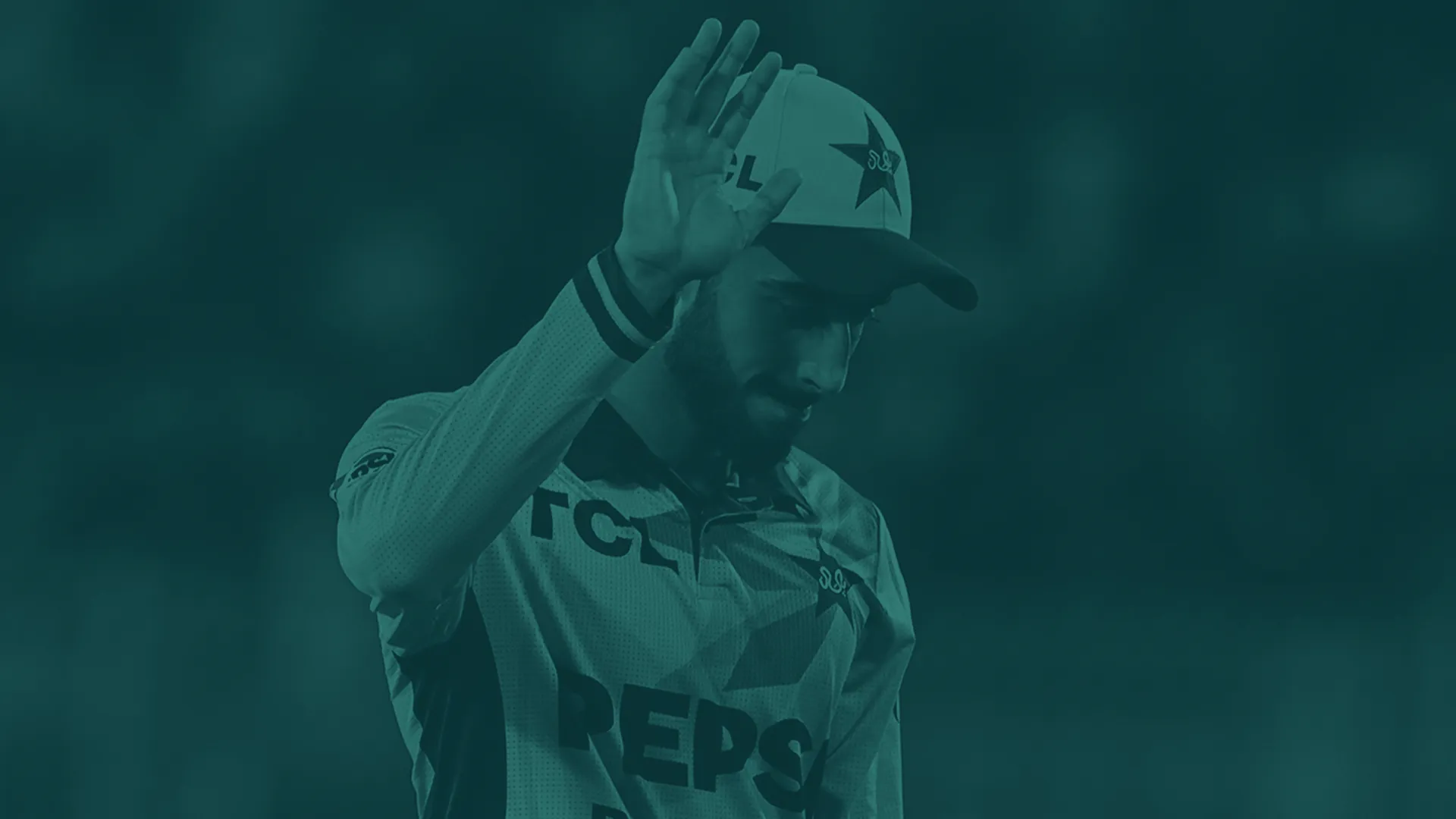
Arafat Five-fer Lights Up Pakistan’s 1,000th ODI
RAWALPINDI: Arafat Minhas celebrated his ODI debut by picking up the player of the match award after becoming the first Pakistani bowler to take a five-wicket haul on debut as Pakistan defeated Australia by five wickets in their historic 1,000th ODI — though the match itself fell well short of the occasion it was meant to mark.
The 21-year-old left-arm spinner became the 261st player to make an ODI debut for Pakistan and returned figures of 10-1-32-5. Abrar Ahmed and Salman Ali Agha, the other two spinners, shared three wickets between them, conceding 65 runs in 15 overs, while fast bowlers Shaheen Shah Afridi and Haris Rauf collected the last two wickets, giving away 43 runs in 11.1 overs, as Australia were spun out for 200 in 44.1 overs after being sent in to bat.
Despite the spin-friendly conditions, Shadab Khan — playing his first ODI since the ICC Men’s Cricket World Cup 2023 match against England in Kolkata — returned figures of 8-0-54-0.
Pakistan achieved the 201-run target in 42.3 overs. Babar Azam and Muhammad Ghazi Ghori featured in a 127-run third-wicket partnership off 156 balls after Maaz Sadaqat (8) and Sahibzada Farhan (28) had fallen at 49. Salman Ali Agha (6) was the fifth Pakistan batter dismissed, with six runs still required.
Babar survived two scares before being bowled by a delivery that struck the bottom of the off-stump, having scored 69 from 94 balls with four fours and a six — his 38th ODI half-century. Ghazi, playing only his second ODI, scored 65 from 92 balls with eight fours before being given out lbw to a slower delivery that kept low.
The match produced 402 runs in total, with only 38 fours and three sixes, and 62.3 of 86.4 overs bowled by the slow bowlers — not the kind of cricket the packed Rawalpindi crowd and Pakistan’s global fanbase had hoped for on such a landmark occasion.
Arafat Minhas, who has taken 18 wickets in 20 List-A matches, produced a performance to remember in Pakistan’s milestone match — one that made them the third side, after India (1,075) and Australia (1,020), to reach four figures in ODIs.
After Australia reached 62 for one, the Multan-born spinner removed captain Josh Inglis lbw on the 19th ball of his international career. He then dismissed Marnus Labuschagne lbw and Cameron Green bowled in the space of four balls to leave the visitors reeling at 68 for four. Matthew Short became Arafat’s fourth victim, stumped in the bowler’s eighth over, before Arafat completed his five-wicket haul on the penultimate ball of his 10-over quota by bowling Nathan Ellis.
Abrar Ahmed had provided the initial breakthrough when he dismissed Alex Carey and later added the wicket of Matthew Renshaw, who was Australia’s top-scorer with a 63-ball 61 containing five fours and a six. Salman Ali Agha claimed the wicket of teenage debutant Oliver Peake, caught behind by Muhammad Ghazi Ghori.
Alongside Renshaw, opener Short scored 55 from 76 balls with six fours, while number-eight Matthew Kuhnemann contributed 24.
Australia’s batters struggled to convert small partnerships into significant ones in the spin-friendly conditions. The biggest stand of the innings was a 55-run fifth-wicket partnership between Short and Renshaw from 65 balls. Other partnerships of note were 34 runs each for the first wicket between Carey and Short, and the seventh wicket between Renshaw and Kuhnemann.
Pakistan marked their 1,000th ODI with a convincing victory and Arafat Minhas lit up the occasion with a memorable debut, but the decision not to prepare a better batting surface is difficult to fathom. Batters on both sides were unable to play their natural game — a significant concern given that these matches are meant to serve as preparation for the ICC Men’s 50-over Cricket World Cup 2027, which is expected to be played on the good batting surfaces of South Africa, Zimbabwe and Namibia.
Pakistan have now won five of their last seven ODIs against Australia, are on course to complete a hat-trick of series wins against the world champions and have reduced the head-to-head deficit against the world’s number-one ranked side to 71-37. The bigger question, however, is whether they are planning for next year’s World Cup with sufficient rigour and professionalism.
Pakistan’s record in major tournaments in recent years makes for sobering reading. Strange selection strategies and inconsistent preparation have contributed to first-round eliminations from the ACC 50-over Asia Cup 2023, the ICC Men’s 50-over World Cup 2023, the ICC Men’s T20 World Cup 2024 and the ICC Champions Trophy 2025, three successive defeats to India in the ACC Asia Cup 2025, failure to reach the semi-finals of the ICC Men’s T20 World Cup 2026, and four successive Test defeats against Bangladesh alongside drawn home series against the West Indies and South Africa.
According to the current ICC Men’s Future Tours Programme, Pakistan are scheduled to host Zimbabwe and a tri-nation series also featuring England and Sri Lanka. Unless additional ODI series against leading sides are arranged, Pakistan have just seven ODIs in which to prepare for next year’s World Cup — a figure that looks wholly insufficient for the 1992 world champions given the scale of the planning and preparation required.
Scores in brief:
1st ODI – Pakistan beat Australia by five wickets, Rawalpindi
AUSTRALIA 200 all-out, 44.1 overs (Matt Renshaw 61, Matthew Short 55, Matthew Kuhnemann 24, Alex Carey 19; Arafat Minhas 5-32, Abrar Ahmed 2-44)
PAKISTAN 202-5, 42.3 overs (Babar Azam 69, Muhammad Ghazi Ghori 65, Arafat Minhas 18 not out; Nathan Ellis 2-45)
PLAYER OF THE MATCH – Arafat Minhas (Pakistan)
2nd ODI – Tuesday, 2 June, Lahore.

GRC Staff
Lorem ipsum dolor sit amet, conse ctetuer adipiscing elit, sed diam nonum nibhie. Aenean sollici tudin, lorem auci elit consequat ipsutis sem niuis sed odio sit amet nibh vulputate cursus.




Leave a Reply