

999 and Counting: Pakistan’s Historic Odi Ride
LAHORE: On 11 February 1973, eleven cricketers walked out at Lancaster Park in Christchurch to play only the fifth ODI ever contested. Intikhab Alam led the side. Majid Khan, Mushtaq Mohammad, Sadiq Mohammad, Sarfraz Nawaz, Asif Iqbal, Wasim Bari, Wasim Raja, Nasim-ul-Ghani, Saleem Altaf and Asif Masood completed the XI.
Few could have imagined that 53 years later, Pakistan would be preparing for their 1,000th ODI.
That moment arrives today (Saturday, 30 May 2026), when Shaheen Shah Afridi leads Pakistan out against Australia in Rawalpindi — a milestone only India and Australia have previously reached.
It has been some journey.
ODI cricket itself was barely two years old when Pakistan played that first match in Christchurch. The format had been born almost by accident in January 1971, when a rain-abandoned Ashes Test at Melbourne was hastily replaced by a 40-over game between Australia and England, drawing 46,000 spectators to the MCG. England and Australia played four of the first five ODIs between them.
Pakistan’s debut was only the fifth match ever played in the format — a 40-over, eight-balls-per-over contest on a February afternoon at the other end of the world.
Pakistan won the toss and chose to bowl. Sarfraz Nawaz led the attack magnificently, taking four for 46 as New Zealand were dismissed for 187, with Mark Burgess top-scoring with 47. Chasing 188, Pakistan never quite got going. Sadiq Mohammad made 37 — the highest score in their innings — but Dayle Hadlee’s four for 34 proved too much. Pakistan were bowled out for 165, losing by 22 runs.
It was a defeat, but it was a beginning.
From those modest origins, Pakistan have built one of the great records in the history of the game.
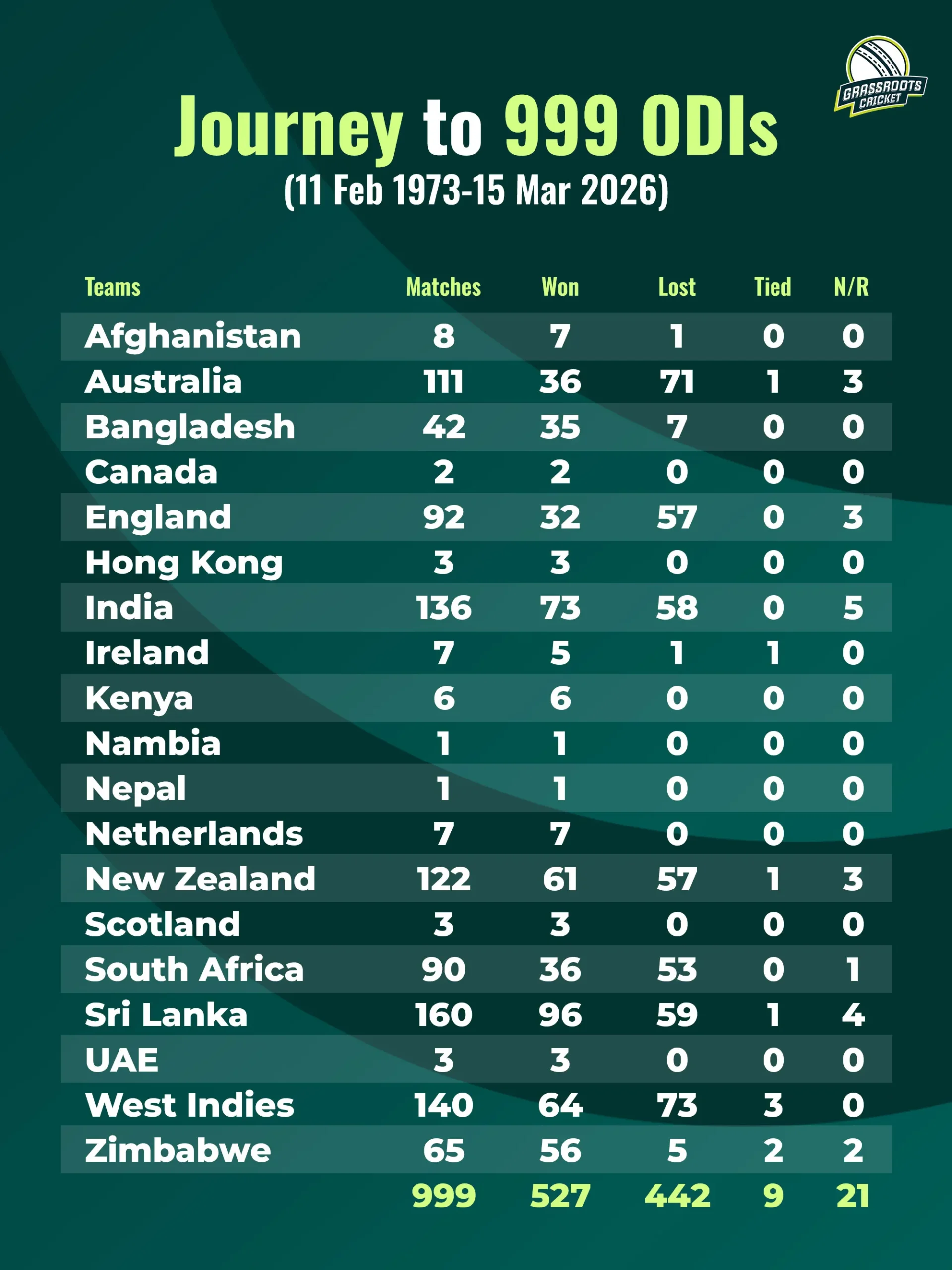
Across 999 ODIs spanning 53 years, 19 opponents, five continents and 254 players, they have won 527 matches and lost 442, with nine ties and 21 no-results. Only India, with 1,075 matches and 571 wins, and Australia, with 1,019 matches and 617 wins, have played more.
Pakistan’s ODI story has been written by some of the most extraordinary cricketers the game has produced.
Shahid Afridi tops the appearances list with 393 ODIs between 1996 and 2015 — a span of 19 years that speaks to both his longevity and his ability to reinvent himself across different eras. Inzamam-ul-Haq played 375 ODIs, accumulating 11,701 runs — more than any other Pakistan batter in the format. Wasim Akram played 356 ODIs and took 502 wickets, a record that remains the benchmark for left-arm pace bowlers anywhere in the world. Between them, those three players alone account for 1,124 matches — more than the entire ODI history of most cricketing nations.
Long before them, it was Zaheer Abbas who set the standard for what a Pakistani batter could be. One of the most elegant and stylish batters to grace the 50-over format, Zaheer brought a majestic grace to the crease between 1974 and 1985. In just 62 ODIs, he accumulated 2,572 runs at a remarkable average of 47.62, striking seven centuries and 13 half-centuries while collecting eight Player of the Match awards. His contribution to the leadership narrative was equally significant, captaining the side in 13 ODIs, winning seven and losing five.
The captaincy story is equally rich. Thirty-one different players have led Pakistan in ODIs — a number reflecting both the country’s depth of talent and the instability that has occasionally characterised its cricket.
Imran Khan led the side in 139 matches, winning 53.95 per cent of them. Wasim Akram captained in 109 ODIs with a win percentage of 60.55 — the best of any Pakistan captain to have led the side in more than 50 matches. Inzamam-ul-Haq won 58.62 per cent of his 87 matches in charge.
The statisticians have had plenty to work with across five decades. Inzamam’s 11,701 runs lead the batting charts, followed by Mohammad Yousuf’s 9,554 from 281 matches and Saeed Anwar’s 8,824 from 247. Anwar and Babar Azam share the record for most centuries — 20 each — though Babar has reached the landmark in just 140 innings compared to Anwar’s 247, underlining just how prolific the former captain has been.
Behind Wasim’s 502 wickets stand Waqar Younis’s 416 from 262 matches and Shahid Afridi’s 393 from 393 — a remarkable one-per-match average across a career spanning nearly two decades. Behind the stumps, Moin Khan’s 287 dismissals from 219 matches make him Pakistan’s most prolific ODI wicketkeeper.
No country has produced a richer seam of all-round talent. Wasim contributed 3,717 runs alongside his 502 wickets; Afridi scored 8,027 runs and took 393 wickets; Abdul Razzaq, Shoaib Malik and Mohammad Hafeez all cleared 5,000 runs and 100 wickets.
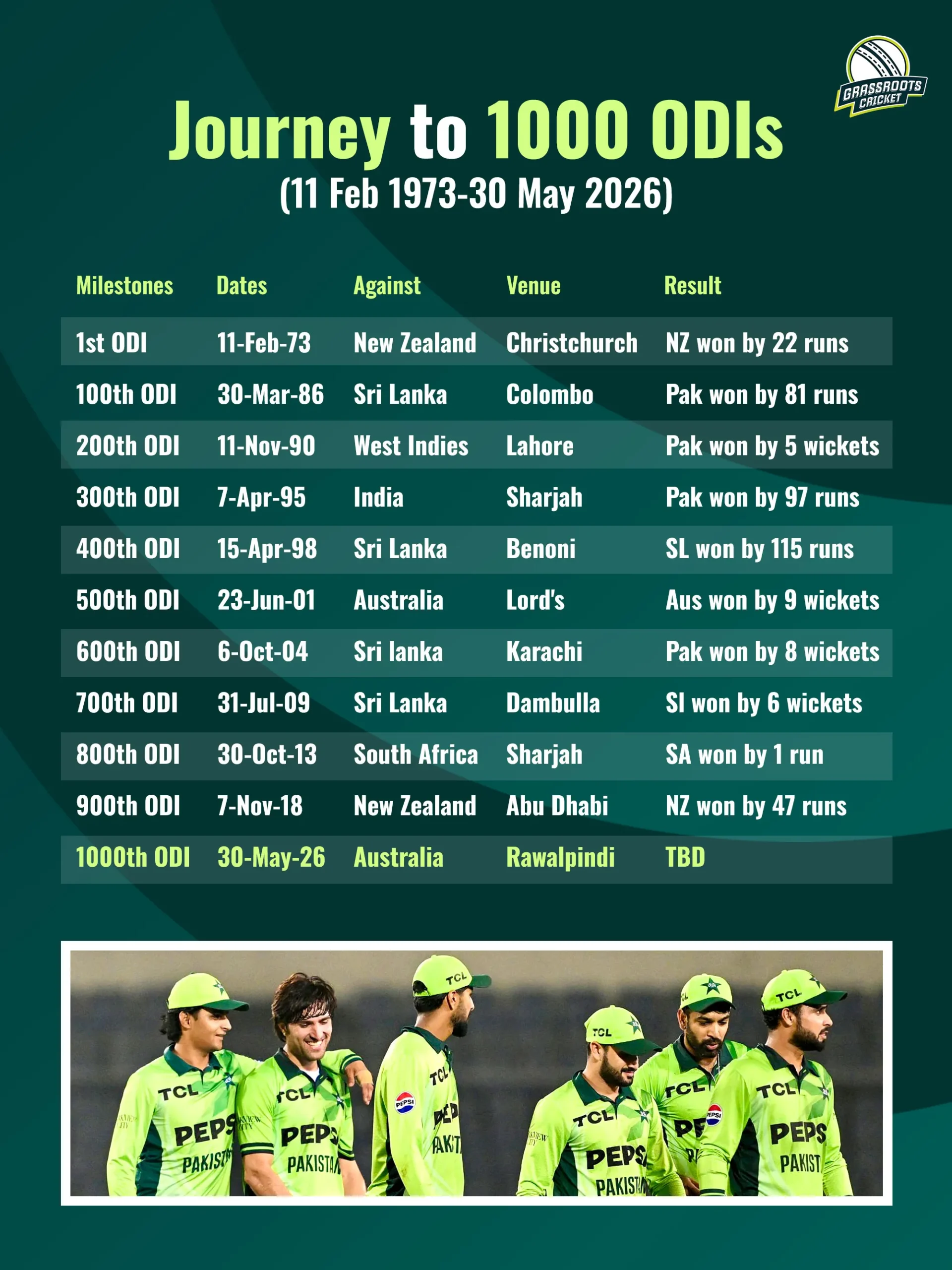
Every century of ODIs has brought its own milestone moment. The 100th was a win — Pakistan beat Sri Lanka by 81 runs in Colombo in March 1986. The 200th brought a five-wicket victory over the West Indies in Lahore in November 1990. The 300th was a commanding 97-run win over India in Sharjah in April 1995. The 600th was an eight-wicket demolition of Sri Lanka in Karachi in October 2004.
Not every milestone has been kind. The 400th ended in a 115-run defeat to Sri Lanka in Benoni in 1998, the 500th in a nine-wicket loss to Australia at Lord’s in 2001. The 800th was perhaps the cruelest of all — a one-run defeat to South Africa in Sharjah in October 2013. The 900th ended in a 47-run loss to New Zealand in Abu Dhabi in November 2018. The 1,000th, this afternoon in Rawalpindi, is yet to be written.
The peaks and valleys of the journey tell their own story.
Pakistan’s finest streak was 12 consecutive ODI victories between November 2007 and June 2008 — a run that captured the imagination and showed what this side could be at its best. They also won 10 in a row from April to November 1990.
The darkest period came between January and May 2019 when they suffered 11 consecutive defeats — their longest losing run in the format — while a sequence of 10 losses between October 1987 and March 1988 remains the second worst. Pakistani cricket has never lacked drama in either direction.
No chapter of Pakistan’s ODI story is more colourful than the Sharjah years.
From 1984 to 2019, the Sharjah Cricket Stadium in particular and the United Arab Emirates in general became Pakistan’s second home — a unique and extraordinary setting where subcontinental cricket reached a fever pitch. Of the 415 matches Pakistan have played at neutral venues, 126 were in the UAE, and they won 83 of them.
Those matches — particularly the duels with India before packed and passionate crowds — were the defining contests of a generation. Javed Miandad’s last-ball six off Chetan Sharma in 1986 remains arguably the single most celebrated moment in Pakistan ODI history. The shot has become part of cricket folklore.
For an entire generation of Pakistani fans, Sharjah was not just a venue — it was a sanctuary, a stage and a second home all at once.
Home, in the more conventional sense, has always been where Pakistan are at their most formidable. Their record on home soil across 210 matches stands at 132 wins — a strike rate that underlines just how much advantage they derive from familiar conditions and passionate home support. They have also been effective at neutral venues, winning 224 of 415 matches, including 83 of 126 in the UAE, while holding their own away from home with 171 wins from 374 matches.
That is what makes the decade of exile between 2009 and 2019 so striking. Pakistan were deprived of the conditions in which they are most dangerous, forced to play 67 ODIs in the UAE while their own grounds sat empty.
That Pakistan not only survived that decade but continued to compete, develop players and win matches is a testament to the resilience that has always defined their cricket.
The return of international cricket to Pakistan — gradual at first, then gathering momentum — has been one of the great restoration stories in the sport. That today’s historic 1,000th ODI is being played in Rawalpindi, in front of a Pakistani crowd, with Australian cricketers in the visiting dressing room, would have seemed almost unimaginable during those long years of exile.
Pakistan’s finest hour in 50-over cricket came at the 1992 World Cup in Australia and New Zealand. Imran Khan’s side were written off early, sitting at the bottom of the table at one stage with their campaign apparently over. Imran famously urged his players to “fight like cornered tigers” — and they did. Five consecutive victories carried them to the final at the MCG, where they beat England by 22 runs — the same margin, in ironic symmetry, by which they had lost that very first ODI in Christchurch 19 years earlier.
Yet while that 1992 global crown remains the uncontested pinnacle, Pakistan’s cabinet has been enriched by triumphs in other major multi-nation tournaments. Chief among them was the unforgettable ICC Champions Trophy success of 2017 in England, where a vibrant side stunned the world by defeating India in a clinical final at The Oval.
Beyond global ICC events, Pakistan’s continental dominance was underlined by Asia Cup triumphs in 2000 and 2012. Their legacy as masters of tournament cricket was forged even earlier through victories abroad: the prestigious Nehru Cup in India in 1989, a historic tri-nation series triumph over the West Indies and hosts Australia in 1997, a thrilling victory over India in the Silver Jubilee Independence Cup final in Dhaka in 1998, and a series of titles in Sharjah during the 1990s.
That 1992 triumph remains the only 50-over World Cup they have won. They came agonisingly close to a second in 1999, reaching the final in England before losing heavily to Australia. Semi-final appearances in 1979, 1983, 1987 and 2011, together with quarter-final exits in 1996 and 2015, complete a World Cup record that is distinguished if not quite gilded.
Australia, today’s opponents, lead the all-time head-to-head 71-36 from 111 matches. Yet that record has been shifting. Pakistan have won the last two bilateral series between the sides, in 2022 and 2024, and arrive at this historic occasion with momentum on their side, while Australia are without Pat Cummins, Mitchell Starc, Josh Hazlewood, Travis Head and Mitchell Marsh.
The most recent addition to Pakistan’s ODI roll of honour is Saad Masood — the 260th player to represent the country in the format. He played his ODI against Bangladesh in March 2026. A long way from Intikhab Alam, who wore the shirt first on that February afternoon in Christchurch.
Between them, those 260 players — from the greats of the 1970s and 1980s to the world champions of 1992, through the Sharjah warriors, the exiled generation and the current crop — have produced moments of brilliance, heartbreak, controversy and triumph that have made Pakistan one of the most watchable and compelling sides in world cricket.
It began with a 22-run defeat in Christchurch. It continued through Sharjah and the MCG and Lord’s and the UAE and back home again.
And now, in Rawalpindi, under a May sky, it reaches one thousand.
One thousand up. The journey continues.

GRC Staff
Lorem ipsum dolor sit amet, conse ctetuer adipiscing elit, sed diam nonum nibhie. Aenean sollici tudin, lorem auci elit consequat ipsutis sem niuis sed odio sit amet nibh vulputate cursus.




Leave a Reply