
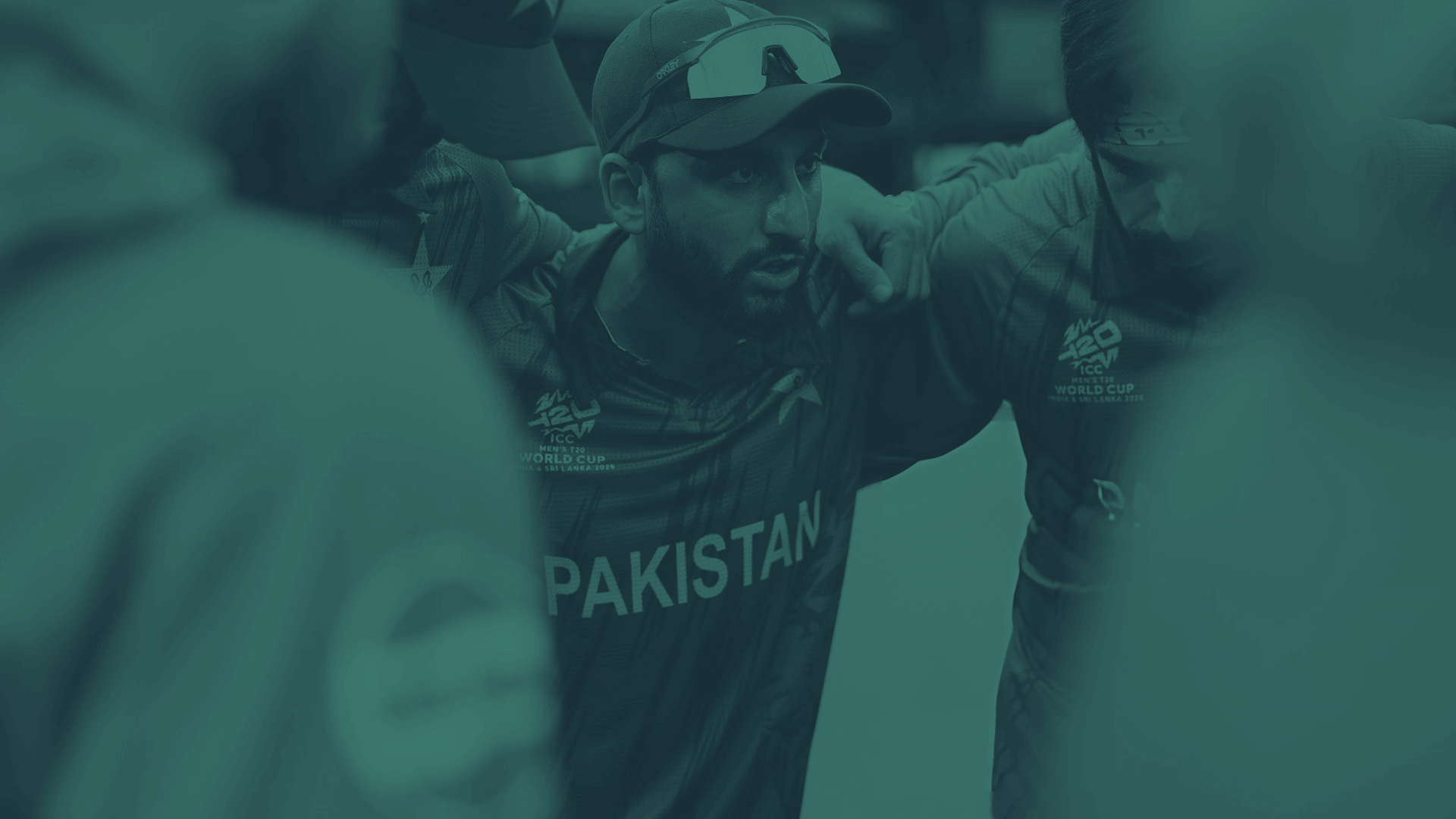
Pakistan’s Super Eight Survival Test
LAHORE: They blow hot, they blow cold. In the high-octane theatre of international cricket, this has become the definitive shorthand for the Pakistan national team. It is a reputation they have worn like a badge of volatile honour, and they proved the pundits right once again during the opening rounds of the ICC Men’s T20 World Cup 2026.
After a stuttering start in which they barely scraped past the Netherlands, followed by a clinical dismantling of the USA and a sobering, one-sided defeat at the hands of India, Pakistan have stormed into the Super Eight stage by brushing aside Namibia.
Now, the “Green Shirts” enter the business end of the tournament. The margin for error has evaporated. Their journey towards a potential seventh semi-final appearance begins this Saturday in Colombo against a familiar foe, New Zealand. From there, the road winds through Pallekele for a heavyweight clash with England on 24 February, before a final group-stage encounter against Sri Lanka on 27 February.
With all four sides in this bracket having finished second in their respective opening groups, everyone starts on even terms. The mathematics are simple, yet brutal: any side securing two wins will effectively lock in their progression to the final four.
However, for Pakistan, the primary opponent might not be the Kiwis or the English, but rather their own internal tactical paralysis. To secure that semi-final berth, the team must urgently resolve a playing XI confusion that has left fans and critics alike searching for answers.
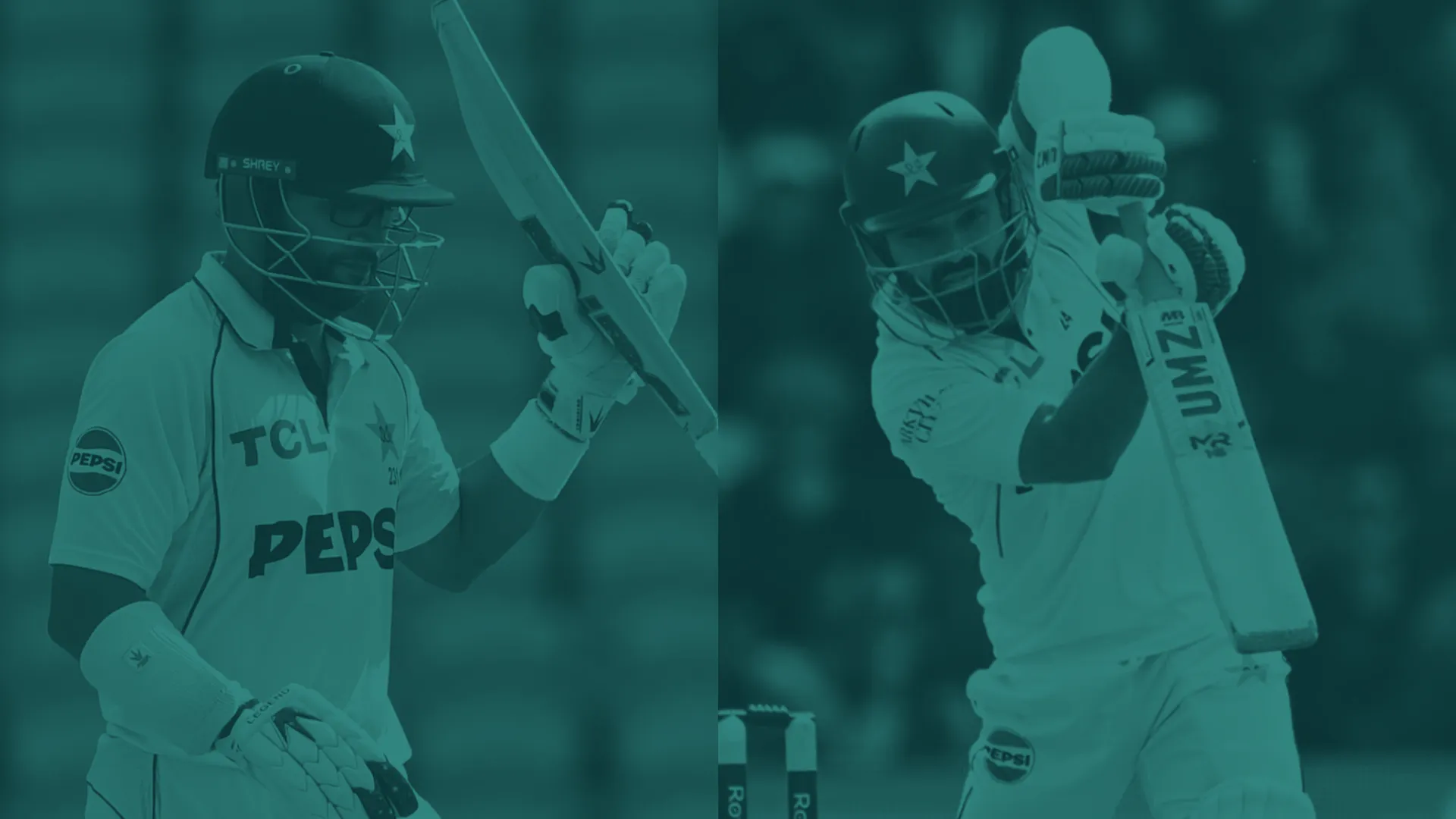
The current line-up is a study in untapped potential and baffling omissions. Saim Ayub has struggled to find his timing at the crease, while the experiment of dropping Babar Azam to No. 4 has yielded more questions than runs. In the bowling department, the utilisation of Faheem Ashraf remains a mystery; he has sent down only two overs across three matches, occupying a spot that many feel belongs to a specialist.
Furthermore, the decision to leave out Abrar Ahmed and Shaheen Shah Afridi against Namibia – coupled with the fact that Fakhar Zaman and Naseem Shah have yet to make an appearance – suggests a “think tank” that is second-guessing its own best assets.
The match against Namibia provided a glimpse into the management’s current mindset, and it was telling. While Pakistan posted a formidable 199 for three, the optics surrounding Babar Azam were concerning. Seeing Khawaja Nafay and Shadab Khan promoted ahead of him signalled a clear lack of confidence from the coaching staff regarding Babar’s ability to accelerate in the middle overs. Because the top order fired, Babar wasn’t required to bat at all.
While this tactical shift confirmed management’s doubts about his power-hitting, it reinforced the argument that Babar has been reduced to a “break glass in case of emergency” anchor. Unfortunately, when that emergency arrived against India, the anchor failed to hold; Babar was bowled by Axar Patel as the side collapsed to a 61-run defeat.
In the aftermath of the India debacle, the spotlight burned brightest on Babar. Critics were quick to question his place in the XI, yet curiously, the architects of that XI – the selectors who picked him in the 15-player squad and the management who penned his name on the team sheet – remained largely shielded from the heat.
As we look towards the Super Eight, the data offer a clear path out of this labyrinth.
Babar Azam has amassed 2,973 runs in 87 T20Is with a career strike rate of 130. However, a deeper dive reveals a stark contrast: when batting at No. 3, 4, or 5, his strike rate plummets to 114 over 48 innings. Common sense dictates that if Pakistan wish to utilise Babar’s immense talent, he must open, pushing Saim down to either 3 or 4.
The suggestion to pair him back at the top with Sahibzada Farhan is gaining significant traction – not merely as a nostalgic callback, but as a pragmatic necessity to stabilise a top order that looks increasingly fragile.
If the management are willing to be bold, an alternative blueprint is emerging.
Many analysts are calling for the inclusion of Fakhar Zaman in place of Babar and Naseem Shah in place of Faheem Ashraf. This would result in a balanced, aggressive line-up consisting of: Sahibzada Farhan, Saim Ayub, Salman Ali Agha, Fakhar Zaman, Usman Khan, Khawaja Nafay, Shadab Khan, Mohammad Nawaz, Naseem Shah, Usman Tariq, and Salman Mirza.
This structure breaks down into three specialist batters, four high-utility all-rounders, and three frontline specialist bowlers. It is a philosophy built on modern T20 realities: if your top eight batters cannot post a winning total, a ninth batter is unlikely to save the day. Conversely, the inclusion of three specialist wicket-takers – including Naseem Shah – provides Pakistan with the aggressive options needed to break partnerships and curtail the flow of runs in the death overs.
As the debate rages across traditional and social media, history offers a glimmer of hope.
Against New Zealand, Pakistan hold a slight historical edge, winning 24 of their 49 encounters. In T20 World Cup play, that dominance is even more pronounced; Pakistan have won five of their seven T20 World Cup meetings against the Black Caps, including the high-pressure clashes in 2021 and 2022.
The challenge grows steeper against England. Pakistan have never beaten the 2009 champions in a T20 World Cup, losing all three previous meetings, including the heartbreaking 2022 final. Against Sri Lanka, the record is a dead heat at 2-2, making their 27 February encounter a potential “do or die” knockout game.
Ultimately, talent has never been the issue for Pakistan. Whether under the leadership of Salman Ali Agha or the veteran guidance of the senior core, the ability to win is there.
If the team can silence the noise, commit to a logical batting order, and unleash their specialist bowlers, they have every chance of earning that seventh semi-final ticket. And in the world of Pakistan cricket, where they blow hot and cold, a “hot” week in Sri Lanka could lead them straight to a blockbuster rematch against India in the final.

GRC Staff
Lorem ipsum dolor sit amet, conse ctetuer adipiscing elit, sed diam nonum nibhie. Aenean sollici tudin, lorem auci elit consequat ipsutis sem niuis sed odio sit amet nibh vulputate cursus.

Leave a Reply