
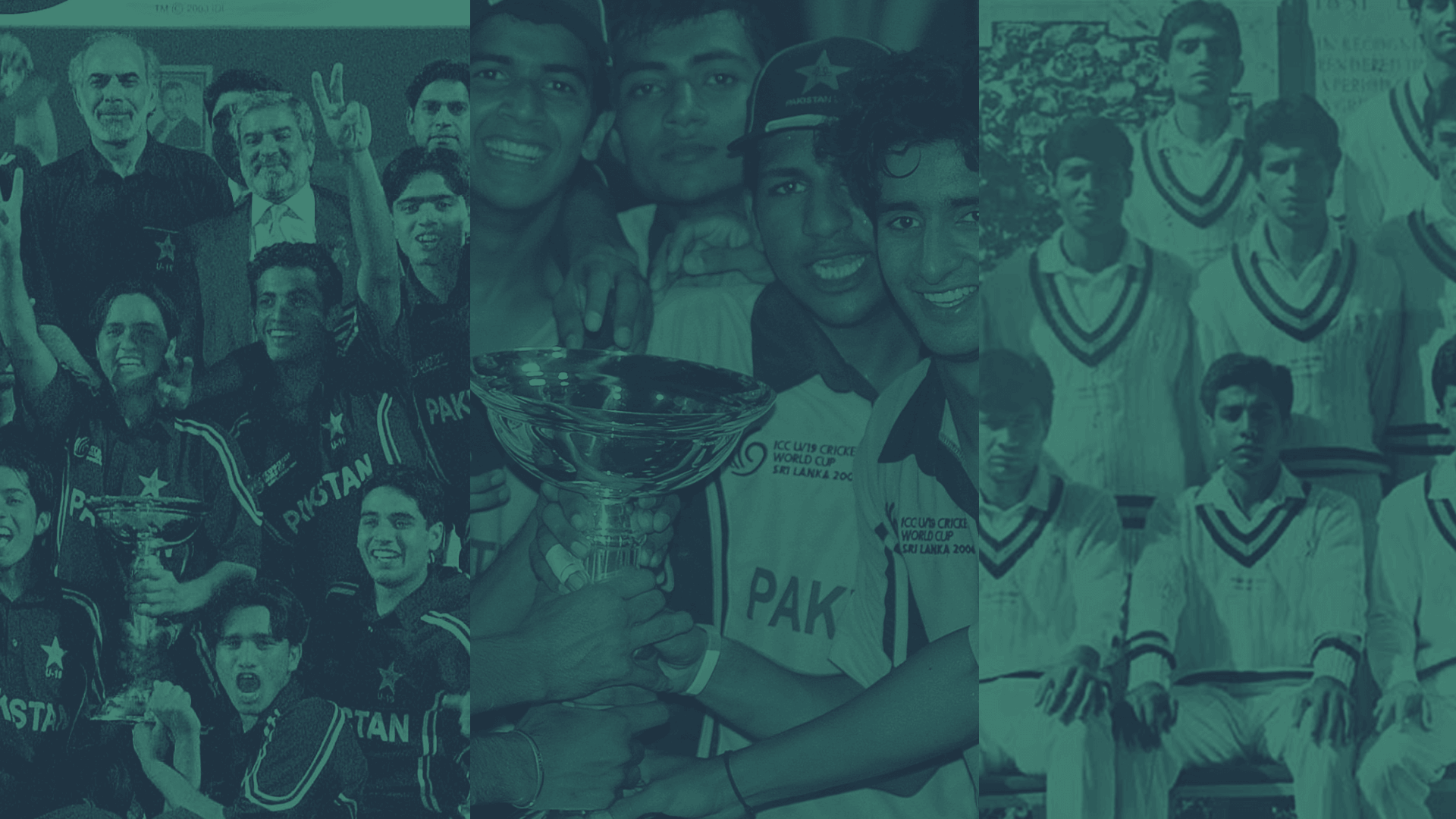
Pakistan at the ICC Men’s U19 Cricket World Cup: 1988–2024
Few pathways in cricket are as revealing as the ICC Men’s Under-19 Cricket World Cup. For Pakistan, it has long been a proving ground – a stage where raw pace, fearless stroke-play, and leadership under pressure first come into focus, years before names become household headlines.
Across 15 editions, from the inaugural 1988 tournament to the most recent event in 2024, Pakistan’s U19s have delivered two world titles (2004 and 2006), reached multiple finals, and repeatedly supplied the senior team with top-tier talent.
What follows is a concise, edition-by-edition record of Pakistan’s journey: where they finished, who carried the campaign, and which teenagers went on to represent Pakistan on the international stage.
1988 – Australia
Pakistan’s U19 story began in style at the inaugural tournament in Australia, reaching the final at the Adelaide Oval before losing to the hosts by five wickets. Shahid Anwar, with 300 runs, and leg-spinner Mushtaq Ahmed, with 19 wickets, topped Pakistan’s batting and bowling tables, respectively. A teenage Inzamam-ul-Haq scored 223 runs in nine matches, including 37 in the final. Other star performers were opener Zahoor Elahi (235 runs) and bowlers Shakeel Khan and Zulfiqar Butt (11 wickets each). Pakistan finished as runners-up, but the legacy was immediate: Inzamam, Mushtaq, Aqib Javed, and Basit Ali all went on to represent Pakistan with distinction at the senior level.
1998 – South Africa
The World Cup returned in an expanded format in South Africa. Pakistan progressed beyond the first phase but fell short of the title rounds, exiting in seventh position. Even so, the tournament produced future Pakistan mainstays: Abdul Razzaq (leading wicket-taker with 12 wickets) and Hasan Raza (leading run-scorer with 212). The squad also included future internationals such as Bazid Khan, Shoaib Malik, and Humayun Farhat, offering an early snapshot of the next generation. Imran Tahir also played for Pakistan in this edition before later ending his career as an international cricketer for South Africa.
2000 – Sri Lanka
Pakistan’s 2000 campaign in Sri Lanka ended on the podium, finishing third after a competitive run in the subcontinental conditions. Faisal Iqbal led Pakistan’s run-scoring with 135 runs, while seamer Zahid Saeed was the strike bowler with 15 wickets. The long-term value was clear: Taufeeq Umar, Humayun Farhat, Yasir Arafat, Imran Nazir, Danish Kaneria, Imran Farhat, and Mohammad Sami all went on to have significant Pakistan careers, while others became domestic stalwarts and Pakistan ‘A’ regulars.
2002 – New Zealand
New Zealand hosted the fourth edition of the U19 World Cup in 2002. Pakistan endured a tougher tournament, finishing fifth after an uneven Super League. Salman Butt was the bright spot with the bat, topping the charts with 166 runs, while Umar Gul led the bowling with 11 wickets, showing the control that would later define his international career. Although the overall finish was below Pakistan’s standards, the edition still delivered future senior players – most notably Azhar Ali (who was selected as a wrist spinner), Salman Butt, and Umar Gul.
2004 – Bangladesh
Pakistan returned to the summit in 2004, winning the title in Bangladesh with a balanced side that delivered in the biggest moments. Khalid Latif topped the batting chart with 291 runs, while Riaz Afridi grabbed 10 wickets to finish as the pick of the bowlers. Pakistan finished as champions, and Zulqarnain Haider, Fawad Alam, Abid Ali, and Wahab Riaz all progressed to play for Pakistan at the highest level.
2006 – Sri Lanka
Two years later, Pakistan successfully defended their crown in Colombo, Sri Lanka. In a ruthless final, they dismissed India for 71 and won by 38 runs at the R. Premadasa Stadium. In the final, Rameez Raja top-scored with 25, while Anwar Ali grabbed five for 35 to win the Player of the Match award; Akhtar Ayub and Jamshed Ahmed took three and two wickets, respectively. The 2006 squad was stacked with future internationals: Sarfaraz Ahmed became a long-serving wicketkeeper-batter and captain, while Imad Wasim and Anwar Ali both progressed to the national side.
2008 – Malaysia
Malaysia staged the 2008 edition, and Pakistan finished third (losing semi-finalists) after a strong run built around fast bowling. Adil Raza and Ali Asad were the headline acts, taking 12 wickets and scoring 247 runs, respectively. While Pakistan missed the final, Ahmed Shehzad, Umar Amin, Umar Akmal, Mohammad Amir, and Shan Masood later successfully represented Pakistan at the senior level.
2010 – New Zealand
Pakistan reached the final in New Zealand in 2010, finishing as runners-up after a 25-run defeat to Australia. The batting was driven by Babar Azam, who scored 298 runs and finished as the tournament’s third-highest run-getter – an early sign of the consistency that would define his senior career. The squad featured other future internationals, including Ahmed Shehzad and leg-spinner Usman Qadir, while Hammad Azam contributed key all-round value.
2012 – Australia
Hosted by Australia in 2012, Pakistan finished eighth but produced several individuals who reached senior international cricket. Babar Azam captained the side and scored 287 runs, while Mohammad Nawaz scored 199 runs and took 10 wickets. The bowling was led by Zia-ul-Haq (11 wickets). Though the team result was modest, the edition reinforced the pipeline, with Sami Aslam, Imam-ul-Haq, Usman Qadir, and Mir Hamza all going on to represent the national team.
2014 – United Arab Emirates
The 2014 tournament in the UAE ended in disappointment when Pakistan lost the final to South Africa by six wickets, having been dismissed for 131. This followed a series of strong performances in earlier matches. Imam-ul-Haq was the leading run-scorer for Pakistan with 382 runs, while Karamat Ali captured 13 wickets. Despite the final loss, Imam, Kamran Ghulam, Saud Shakeel, and Zafar Gohar all featured for the senior team later on.
2016 – Bangladesh
Bangladesh hosted in 2016, and Pakistan recovered strongly to finish fifth, showing depth beyond a single star. Hasan Mohsin demonstrated his all-round skills, scoring 293 runs and taking 11 wickets, though he was unable to maintain that momentum in later years. In contrast, Shadab Khan also picked up 11 wickets and continues to serve Pakistan on the international stage.
2018 – New Zealand
New Zealand hosted again in 2018, and Pakistan finished third (losing semi-finalists). The pace resources were central to the campaign, with Shaheen Shah Afridi headlining the attack with 12 wickets before his rapid ascent to senior cricket. Ali Zaryab Asif top-scored with 164. Other talents to emerge included Rohail Nazir, Mohammad Musa, and Saad Khan.
2020 – South Africa
The 2020 edition in South Africa saw Pakistan finish third. The campaign highlighted familiar strengths – fast-bowling depth and athletic fielding – even as knockout pressure exposed areas for improvement. Wicketkeeper-batter Mohammad Haris top-scored with 131 runs, and Abbas Afridi was the pick of the bowlers with nine wickets. Other notable performers included Qasim Akram, Mohammad Hurraira, Haider Ali, Mohammad Wasim Junior, and Abdul Wahid Bangalzai.
2022 – West Indies
Pakistan finished fifth in the West Indies in 2022, missing the semi-finals but responding strongly in the placement matches. The tournament showcased a side capable of controlling games with spin. Wicketkeeper-batter Haseebullah top-scored with 380 runs, and Awais Ali took 15 wickets. Most of the squad, including Maaz Sadaqat, Qasim Akram, Zeeshan Zamir, Mehran Mumtaz, and Mohammad Irfan Khan Niazi, have remained in the development pipeline.
2024 – South Africa
In 2024, Pakistan returned to the podium with a third-place finish, falling to Australia by a single wicket in a dramatic semi-final. Opener Shahzaib Khan was the batting standout with 264 runs, well supported by Shamyl Hussain (151) and Azan Awais (147). Pacer Ubaid Shah took 18 wickets – one of the best tallies of the event. Ali Raza also displayed immense potential, taking nine wickets in just three matches. Other prospects to emerge include Arafat Minhas, Saad Baig, Haroon Arshad, and Mohammad Zeeshan.

GRC Staff
Lorem ipsum dolor sit amet, conse ctetuer adipiscing elit, sed diam nonum nibhie. Aenean sollici tudin, lorem auci elit consequat ipsutis sem niuis sed odio sit amet nibh vulputate cursus.

Leave a Reply