
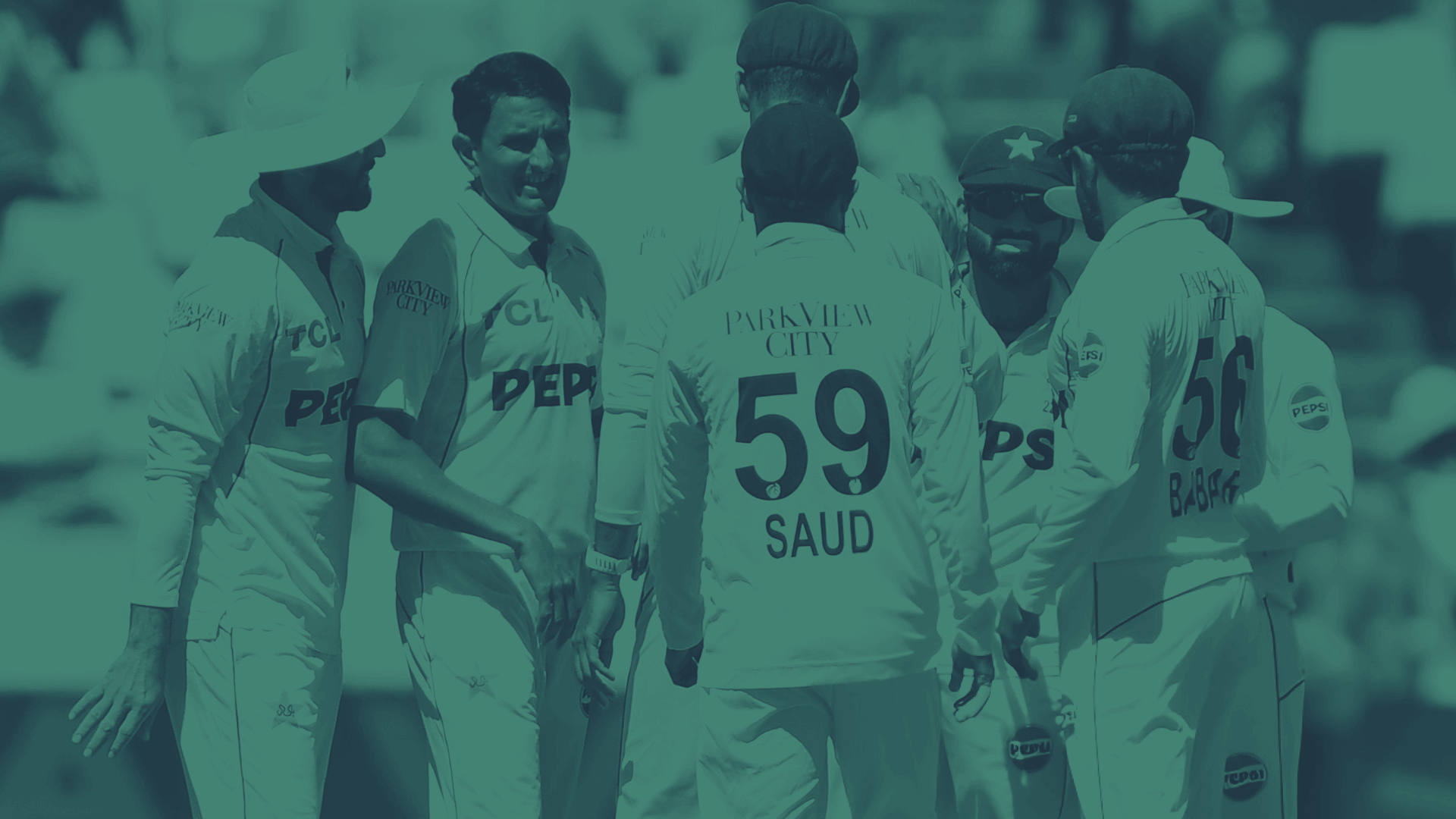
WTC 2025-27 – An Opportunity For Pakistan To Redeem Test Prowess
LAHORE: Pakistan finished sixth in the inaugural ICC World Test Championship (WTC) 2019-2021, but then plummeted to seventh and ninth in the two subsequent cycles. In a nine-team event, the team cannot fall any further and now has only one direction: to redeem itself as it launches its 2025-2027 campaign against WTC champions South Africa in Lahore on Sunday.
Before previewing the Pakistan vs South Africa Test series, it’s crucial to briefly review the factors that led to the once-mighty Pakistan side’s fall from grace in the format once considered its forte and fortress.
The Decline by the Numbers
For those who rely on data, Pakistan’s WTC performance since 2019 is stark. In 40 Tests, they have won 13 and lost 20. This is particularly disappointing when compared to the preceding five-year period (Jan 2014–June 2019), where they won 19 and lost 22 in 45 Tests.
Looking at the broader historical context:
- 2008–2013: 43 Tests played, 14 won, 17 lost.
- 2000–Present: 204 Tests played, 77 won, 86 lost.
- 1975–1999: 187 Tests played, 63 won, 41 lost.
These numbers clearly provide the context for the argument: Pakistan Test cricket has been in a slow but steady decline, touching bottom in the ICC WTC 2023-25 cycle.
Analysing the Factors of Underperformance
Several factors likely contributed to the below-par, and at times poor, performance in the ICC WTC.
While there has been relative consistency in captaincy – with three captains since 2019 (Azhar Ali, Babar Azam, and Shan Masood) – the coaching setup has been a revolving door, cycling through five red-ball coaches: Misbah-ul-Haq, Saqlain Mushtaq, Mohammad Hafeez, Jason Gillespie and Aqib Javed. Azhar Mahmood will be the sixth coach when the series commences on Sunday.
Is consistency to blame? Shan Masood is the captain for the South Africa series, with Azhar Mahmood as the interim head coach until early next year. While Mahmood is unlikely to get an extension, the 35-year-old Masood’s captaincy is also hanging by a thread. Another series loss, and we may see yet another change.
Beyond the personnel, one must ask: has the PCB done little to introduce consistency and continuity in the red-ball set-up because Test cricket is no longer a priority? Has it been overshadowed by the glamour and cash-attraction of white-ball cricket, specifically T20?
Mixed Messages from the Board
The PCB’s decision-making regarding the Test team coaching structure and central contracts sends mixed messages about its seriousness in regaining lost glory.
For instance, Test captain Shan Masood was demoted two categories to “D” in the men’s central contracts for 2025-26. Similarly, the spin duo of Noman Ali and Sajid Khan – who inspired a 2-1 series win against England and a 1-1 draw against the West Indies last season – were retained only in Category C, along with vice-captain Saud Shakeel and opener Abdullah Shafqiue.
In a sharp contrast, T20I captain Salman Ali Agha and ODI captain Mohammad Rizwan were placed in Category B, besides Abrar Ahmed, Babar Azam, Fakhar Zaman, Haris Rauf, Hasan Ali, Saim Ayub, Shadab Khan and Shaheen Shah Afridi.
Meanwhile, three emerging players who featured in Pakistan’s last Test against the West Indies in January in Multan – Mohammad Hurraira, Kamran Ghulam, and Kashif Ali – failed to earn central contracts altogether.
The PCB’s actions don’t reflect a commitment to the longest format. Furthermore, preferential treatment, such as not forcing Babar Azam to feature in the opening round of the Quaid-e-Azam Trophy (unlike his teammates), raises legitimate questions about authority and decision-making within the board.
What messages does these send to followers, future stars and investors of Test cricket?
The Road Ahead: South Africa and WTC 2025-27
Instead of dwelling on the sorry past few years, let’s look ahead with optimism and hope.
This new journey begins with the two-Test series against South Africa, followed by fixtures against Bangladesh (away, March 2026), West Indies (away, July 2026), England (away, August 2026), Sri Lanka (home, Nov 2026), and New Zealand (home, March 2027).
If Pakistan manages to reach the final, and they have a realistic chance of achieving that, they will face a three-month gap before England stages the final in June 2027.
A Spin-Heavy Strategy and Batting Concerns
Pakistan have named a spin-heavy squad for the South Africa Tests, confirming that the batters will be challenged throughout the five days – should the match go the distance. While some may question the wisdom of moving away from Pakistan’s traditional strength (fast bowling), the reality is that in the absence of high-quality fast bowlers like in the past, it makes sense to bank on the successful spin duo of Noman and Sajid.
This sparks an interesting debate on the playing combination. With 38-year-old uncapped left-arm spinner Asif Afridi also named, will Pakistan field three spinners? If so, only one spot remains for a fast bowler (either Shaheen Shah Afridi or Khurram Shahzad), as Pakistan intends to stick with seven batters, including Mohammad Rizwan as the wicketkeeper/batter.
Alternatively, Pakistan could omit Asif Afridi and rely on Salman Ali Agha to fulfil the role of a third spinner, creating room for an additional specialist fast bowler.
Irrespective of the bowling combination, the biggest question marks remain against the Pakistan batters. Their poor performance in the WTC 2023-25 cycle, combined with limited exposure to four-day cricket, makes them vulnerable on the spinning Gaddafi Stadium surface.
In the last WTC cycle, Saud Shakeel was the most impressive batter, scoring 1,078 runs at an average just over 43. He was followed by Mohammad Rizwan (900 runs, 45 avge.), Shan Masood (880 runs, 33.84 avge.), and Salman Ali Agha (870 runs, 41.42 avge.).
Babar Azam’s numbers are notably low: 539 runs at an average of 23.43. His critics will be smiling, but the fact remains he must score big to prolong his career. While his technique is not in doubt, the larger concern is his mental strength. Following a poor run of form, the loss of captaincy, and social media abuse, it is hoped he shows the resilience and determination to end his run-drought and silence his critics. He has to let his bat do the talking.
Imam-ul-Haq’s return is positive news after heavy scoring for Yorkshire and in the Hanif Mohammad Trophy. It is hoped his time away from the national side has allowed him to reboot and reset his targets. Insiders suggest his ouster was more due to his behaviour and approach than his ability with the bat.
The Pakistan versus South Africa series promises to be an exciting contest. Captain Aiden Markram’s South Africa will aim to start with a win, while Shan Masood’s Pakistan will hope to bury the past and send a loud and clear message to the world that Pakistan Test cricket is still alive and kicking.
Pakistan last lost a Test series to South Africa at home in 2007, while they won both the Tests in Rawalpindi and Karachi in the 2021 series.
SQUADS
South Africa – Aiden Markram (captain), Dewald Brevis, Tony de Zorzi, Ryan Rickelton, Tristan Stubbs, Kyle Verreynne, Zubayr Hamza (all top-order batters), Corbin Bosch, Marco Jansen, Wiaan Mulder, Senuran Muthusamy, Prenelan Subrayen (all-rounders), Simon Harmer, Kagiso Rabada (bowlers). Keshav Maharaj (available for 2nd Test).
Pakistan – Shan Masood (captain), Abdullah Shafique, Babar Azam, Imam-ul-Haq, Kamran Ghulam, Saud Shakeel (top-order batters), Mohammad Rizwan, Rohail Nazir (wicketkeeper/batters), Salman Ali Agha, Hasan Ali (all-rounder), Asif Afridi, Sajid Khan, Abrar Ahmed, Khurram Shahzad, Noman Ali, Shaheen Shah Afridi (bowlers).

GRC Staff
Lorem ipsum dolor sit amet, conse ctetuer adipiscing elit, sed diam nonum nibhie. Aenean sollici tudin, lorem auci elit consequat ipsutis sem niuis sed odio sit amet nibh vulputate cursus.


Leave a Reply