
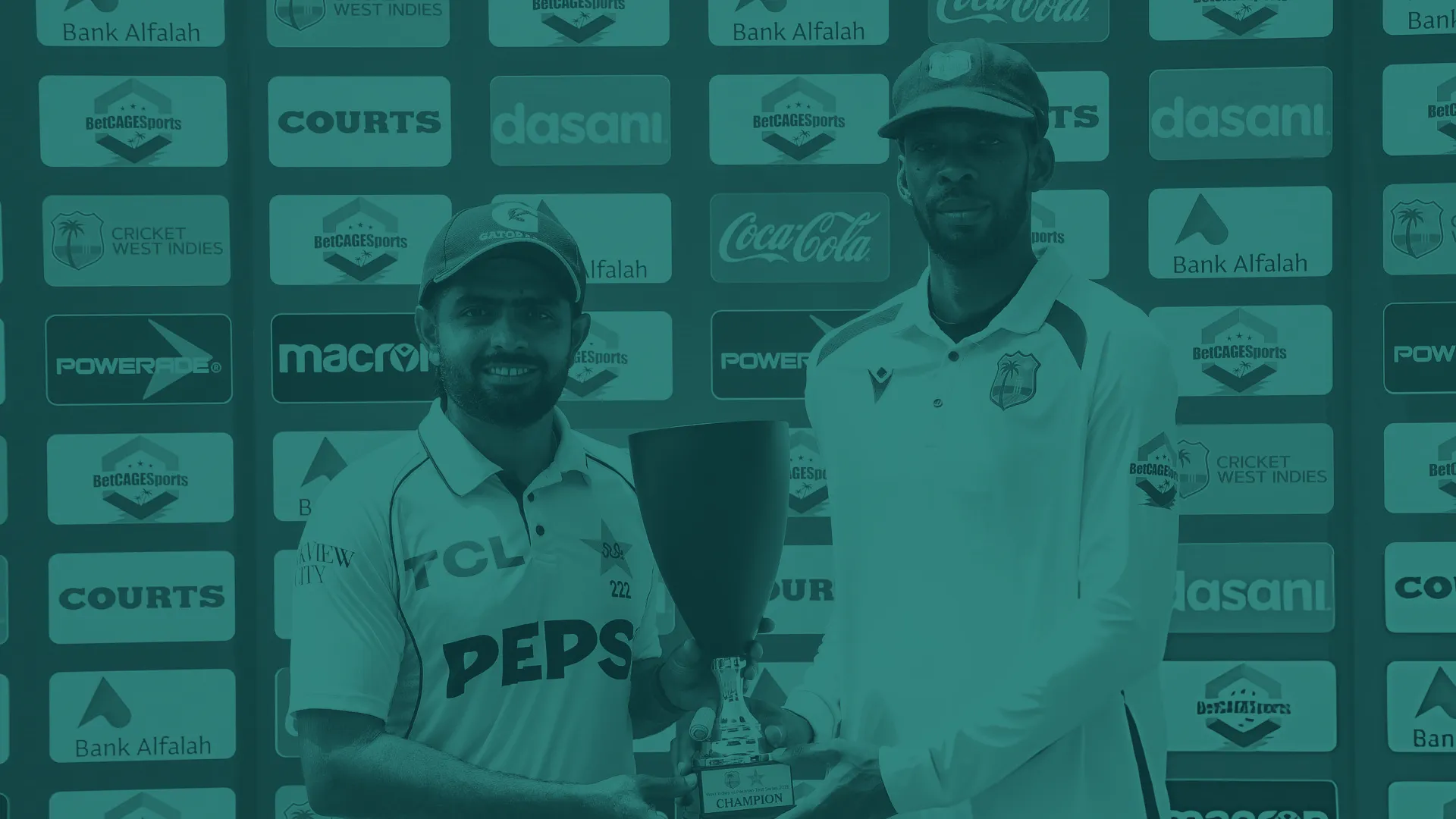
Babar-Sarfaraz Combo Pays an early Dividend
The re-established alignment between Babar Azam and Sarfaraz Ahmed delivered an immediate dividend for Pakistan, arresting an eight-match away losing streak with a drawn two-Test series in the West Indies – while extending an unbeaten Test series run against the Caribbean side that stretches back to 2000.
Babar’s re-appointment as Test captain, having relinquished the post in November 2023, yielded immediate dividends by bringing up Pakistan’s 11th victory under his stewardship across 22 Tests – nine of those triumphs registered on foreign soil. Sarfaraz, meanwhile, was fast-tracked into the head coach position ahead of May’s tour of Bangladesh, ascending to the senior role after guiding Pakistan’s Under-19 side through the ACC U19 Asia Cup and the ICC U19 Cricket World Cup.
The PCB’s unconventional structural model naturally invited skepticism, much of it well-founded. Yet one decisive variable weighed in its favor: a master-and-disciple dynamic forged across a decade. Babar’s international evolution occurred largely under Sarfaraz’s captaincy – a period defined by the 2017 ICC Champions Trophy triumph, a surge to the summit of the T20I rankings, and a rise to third in the Test standings. Of the 100 international fixtures Sarfaraz captained, Babar featured in 88 – a statistic underscoring their tactical and personal synergy.
That alliance endured even after Sarfaraz was relieved of the leadership following a home T20I series against Sri Lanka in 2019. When Babar subsequently assumed the captaincy in 2020-21, he consistently prioritised Sarfaraz’s inclusion within the squad, even as Mohammad Rizwan established himself as the undisputed first-choice wicketkeeper-batter.
Trust, clarity, and shared philosophy form the bedrock of any sustainable leadership structure. Cricket history offers no shortage of transformative pairings: Nasser Hussain and Duncan Fletcher, Pat Cummins and Andrew McDonald, Virat Kohli and Ravi Shastri, Ben Stokes and Brendon McCullum, or Sarfaraz himself alongside Mickey Arthur. Such alliances extend beyond collecting bilateral series or ICC hardware; they fundamentally reshape team culture and tactical identity.
Throughout the series on Trinidadian soil, Babar and Sarfaraz operated with unmistakable synchronicity.
Their strategic hand was evident in every pivotal decision: preferring left-arm spinner Ali Usman over Sajid Khan for the opening Test, drafting Abdullah Shafique as cover for the injured Shan Masood, making the contentious call to omit Mohammad Abbas, and reading the Queen’s Park Oval surface far better than the hosts by replacing Aamir Jamal with Sajid while retaining Ali Usman.
Not every gamble bore fruit, but in Port of Spain, the recalibrated selection was emphatically vindicated: Abdullah and Sajid anchored the eight-wicket victory with an unbeaten first-innings 160 and match bowling figures of eight for 117, respectively.
Those decisive displays carried extra weight given the context of the opening Test in Tarouba, where two severe middle-to-lower-order batting surrenders handed West Indies a 90-run victory. An elite, ruthless side would not have faltered twice in the same match – and might well have departed the Caribbean with a 2-0 sweep rather than a split series.
Babar’s operational control as captain matured noticeably across the Port of Spain fixture. His bowling rotations were flexible, field placements carried intent, over-rates remained disciplined, and his usage of the Decision Review System was precise. Crucially, he anchored the batting unit with contributions of 23, 58*, 88, and 24* across the tour, earning a share of the Player of the Series award alongside Justin Greaves.
A 10th Test century continues to elude him, with his last milestone dating back to the 2022 Boxing Day Test against New Zealand in Karachi. Yet on current trajectory, the drought feels near its end. The upcoming three-Test tour of England – with fixtures at Headingley, Lord’s, and Edgbaston spanning August 19 to September 13 – offers a premier stage to shatter that barrier.
Beyond the overarching narrative of structural recovery, individual contributions provided essential substance.
Twenty-one-year-old opener Azan Awais demonstrated encouraging temperament at the top of the order, accumulating 76 runs. Bowling coach Umar Gul will take equal satisfaction in his frontline quartet – Mohammad Ali, Mohammad Abbas, Sajid Khan, and Ali Usman – who claimed 31 of the 39 West Indian wickets to fall across the series. Mohammad Ali spearheaded the attack with nine wickets, while Abbas and Sajid claimed eight apiece in their solitary appearances. Ali Usman, after going wicketless on debut, responded with a decisive six-wicket match haul in the second Test.
Then came the extraordinary recall of Abdullah Shafique. Omitted from the original squad after attending the pre-tour camp in Lahore, he was drafted from Guyana to replace Shan Masood, who had struck a heroic century in the first Test before suffering a fractured finger. Abdullah’s match-winning first-innings performance in Port of Spain completed a stunning sequence of redemption.
Yet beneath these triumphs, structural vulnerabilities linger.
The form of Imam-ul-Haq, Salman Ali Agha, and Mohammad Rizwan demands urgent correction. Prolonged slumps from Salman and Rizwan directly triggered the loss of seven wickets for 38 runs in the first innings at Tarouba, followed by a slide to 71 for nine in the second. In Port of Spain’s first innings, Pakistan again exposed their lower order, shedding eight wickets for 106 runs.
Such collapses invite relentless pressure from opposition setups, regardless of match context. However, Imam, Salman, and Rizwan possess established international pedigree, and Pakistan will trust them to recalibrate before stepping out at Headingley.
Squad reinforcements are also imminent. Shan Masood (recovering from his finger fracture) and Saud Shakeel (absent in the Caribbean due to fitness concerns) are slated to return for the series opener in Leeds. Their availability hands Babar and Sarfaraz a demanding selection puzzle; with Mohammad Abbas waiting in reserve, it represents a depth Pakistan will gladly navigate.
England will monitor Pakistan’s momentum with interest. The host set-up is navigating its own transitional phase: Joe Root has assumed the Test captaincy for a second spell, while incoming head coach Stephen Fleming will not formally take charge until after the Pakistan series, leaving assistant coach Marcus Trescothick to direct operations on an interim basis. Conversely, Pakistan will arrive with a leadership pairing already displaying operational synergy.
Pakistan played rigorous, uncompromising cricket in the Caribbean, and sustained application across key disciplines gives them the tools to test England in home conditions.
How the coming weeks unfold remains unwritten. For now, Pakistan can take legitimate satisfaction in their achievement at Port of Spain – particularly given the modest pre-departure expectations, epitomised by a senior PCB official suggesting the board would view the tour as a success if the team managed a single victory across five scheduled Test matches.
That modest benchmark may yet be put into prospective context. But across Trinidad, Pakistan displayed resilience, tactical clarity, and unmistakable purpose. The Babar-Sarfaraz era is in its infancy, yet its opening chapter offers a foundation worth investing in.

GRC Staff
Lorem ipsum dolor sit amet, conse ctetuer adipiscing elit, sed diam nonum nibhie. Aenean sollici tudin, lorem auci elit consequat ipsutis sem niuis sed odio sit amet nibh vulputate cursus.



Leave a Reply